Showing posts with label designer of the month. Show all posts

Friday, December 7, 2012

Designer of the Month: Marimekko


While we're now in December, and should technically be moving on from November's Designer of the Month, Marimekko, I thought that it might be fun to slightly extend things by bringing this historic company into the present day. For the last month, we looked at the history of Marimekko, and in particular, the company's founder, Armi Ratia and the many wonderful designers associated with Marimekko during its early years. Although a lot has changed for the company over its 61-year-history, today, Marimekko remains as popular, and as recognizable a brand, as ever. And so, I present you with a look at the modern world of Marimekko fabric printing.


(Photos by Tuukka Koski, Toni Rosvall and Marimekko, via Design Milk)

P.S. Today's my birthday - I'm 30 years old!!! To celebrate, Patrick's taking me here for dinner tonight, and tomorrow, we're getting together with friends to go here. I hope you all have a fun weekend as well!

Friday, November 30, 2012

Designer of the Month: Marimekko

Week 4: later textile and fashion design

Elle Cover featuring an Annika Rimala dress. Courtesy of the Marimekko Blog.

Armi Ratia's eye for young talent continued to shape Marimekko's aesthetic to the company's credit long after its early years. In 1958, Ratia took Marimekko to the World's Fair in Brussels, and the company's designs were thus introduced to an international audience, with Design Research stores soon opening in New York and San Francisco.[1] Although it was around this time that Vuokko Eskolin-Nurmesniemi left the company, the next wave of Marimekko designers were well suited for their new roles in upholding the international image of a successful design brand. In particular, Annika Rimala, Marimekko's fashion designer from 1959-1982, picked up seamlessly where Eskolin-Nurmesniemi had left off.[2]

Liisa Suvanto, Marimekko Ruuturaita Pattern, 1974. Courtesy of the Marimekko Blog.

Originally trained as a graphic designer at the Institute of Industrial Arts in Helsinki, Rimala proved to be a champion of the types of printed patterns that had been popularized by Eskolin-Nurmesniemi, with her designs reflecting a strong sense of graphic awareness.[3] While Rimala began her tenure at Marimekko designing bold graphic prints, which would remain in fashion through the mid-1960s, by the end of this decade, having pushed patterns as far as they could go, the only option that remained was to downsize and embrace uniformity.[4] "Rimala's solution was the Tasaraita (even stripe) collection of cotton jersey casualwear, launched in 1968," explains Lesley Jackson in an essay about Marimekko's textile design; "A runaway hit throughout the 1970s, Tasaraita replaced the flamboyant individualism of large-scale patterns with the high-voltage intensity of saturation stripes."[5] Designer Liisa Suvanto, who was invited by Ratia in 1960 to design Marimekko's "woolen line," and who came to the company on a full-time basis from 1963-1975, represented the next big change for the company.[6] An established textile designer with her own firm and more than 20 year's experience, she developed an elegantly sculptural line of clothing for Marimekko based on the plain and simple cuts of Balenciaga.[7]

 Fujiwo Ishimoto, Kesanto cotton. Courtesy of Marimekko.

The 1970s saw other shifts for Marimekko as well, including changes to the company's furnishing fabrics with the recruitment of two Japanese designers, Katsuji Wakisaka, who worked for Marimekko from 1968-1976, and Fujiwo Ishimoto, who joined the company in 1974 and remains chief furnishing fabric designer to this day.[8] Although these second-generation Marimekko designers introduced new aesthetics to the company, their designs helped expand the Marimekko style and make it more accessible to a world-wide audience.[9] Wakisaka's designs, with their bright pop patterns often drawing inspiration from the idiom of children's drawings, blurred the line between the living room and nursery.[10] Ishimoto's work, on the other hand, with its brushstroke-like and textural patterns, as well as his focus on contrast rather than coordination, were distinctly Japanese in nature, yet managed to uphold Marimekko's overall aesthetic and tradition of maximization.[11]

Pentti Rinta, Marimekko Kuski Suit, 1973. Courtesy of the Marimekko Blog.

The final Marimekko designer whom I want to talk about today came to the company during the new round of innovations that were occurring during the 1970s. Pentti Rinta, who worked at the company from 1969 until the mid-1980s, had the distinction of being the first Marimekko designer to have actually been trained in fashion (at the Institute of Industrial Arts, naturally).[12] Adept at designing for the new, casual, "everyday" style of the 1970s, Rinta's philosophy was that clothes should be comfortable to wear, with being fashionable a secondary concern.[13] As Riitta Anttikoski describes this change in Marimekko's design culture:
If in the early years of Marimekko Nurmesniemi had liberated women from the restrictive clothing of the era, then in the 1970s Rinta freed men from the yoke of the pinstripe suite with his Kuskipuki (coachman suite, 1972)...Ostensibly, the design developed out of necessity. Rinta was leaving for Paris and had made himself a comfortable black corduroy suit to wear on the journey. When Ratia saw it, she told him: "Put it into production!"...The Kuski suit became the uniform of architects, artists, editors, and other professionals. It was later made in fabrics other than corduroy and was adapted for women.[14] 
Rinta's other real breakthrough as a designer came in his 1975 summer collection, for which he produced a new version of the classic shirt dress that suited a wide range of ages and body types, literally typifying the idea of clothes designed for all.[15] While the 1970s saw major changes for Marimekko's designs, and a host of designers to help them along, the biggest change was yet to come with Ratia's death in 1979.[16] The following decade was a difficult one of Marimekko, but the 1990s once again saw the company reinvent itself while simultaneously rediscovering its roots, once again growing into the internationally-recognized brand that remains today.[17]


[1] Marimekko online, "About Marimekko: Timeline," http://us.marimekko.com/unfold/timeline, (accessed November 28, 2012).

[2] Lesley Jackson, "Textile Patterns in an International Context: Precursors, Contemporaries, and Successors," from Marimekko: Fabrics, Fashion, Architecture, ed. Marianne Aav (New York: The Bard Graduate Center for Studies in the Decorative Arts, Design, and Culture, 2003), 67.

[3] Ibid., 67.

[4] Ibid., 67.

[5] Ibid., 67.

[6] Maria Härkäpää, "Selected Biographies of Marimekko Designers," from Marimekko: Fabrics, Fashion, Architecture, ed. Marianne Aav (New York: The Bard Graduate Center for Studies in the Decorative Arts, Design, and Culture, 2003), 300.

[7] Ibid., 300.

[8] Lesley Jackson, "Textile Patterns in an International Context: Precursors, Contemporaries, and Successors," from Marimekko: Fabrics, Fashion, Architecture, ed. Marianne Aav (New York: The Bard Graduate Center for Studies in the Decorative Arts, Design, and Culture, 2003), 69, 70.

[9] Ibid., 69.

[10] Ibid., 69.

[11] Ibid., 70. 

[12] Maria Härkäpää, "Selected Biographies of Marimekko Designers," from Marimekko: Fabrics, Fashion, Architecture, ed. Marianne Aav (New York: The Bard Graduate Center for Studies in the Decorative Arts, Design, and Culture, 2003), 303.

[13] Ibid., 303.

[14] Riitta Anttikoski, "Fashion, Individuality and Industry," from Marimekko: Fabrics, Fashion, Architecture, ed. Marianne Aav (New York: The Bard Graduate Center for Studies in the Decorative Arts, Design, and Culture, 2003), 109.

[15] Ibid., 109.

[16] Ibid, 107.

[17] Marimekko online, "About Marimekko: Timeline," http://us.marimekko.com/unfold/timeline, (accessed November 28, 2012).

Friday, November 23, 2012

Designer of the Month: Marimekko

Week 3: early textile and fashion design

With the creation of Marimekko, rather than simply creating a company that played off of current Finnish design trends, Armi Ratia altered the landscape of printed textiles both at home and abroad. As I mentioned last week, the creation of Marimekko corresponded with Finland's rise on the international design scene. It was during this period that Finland's remoteness and isolation - once perceived as a weakness for the country - actually became its strength.[1] As the writer Anna-Liisa Ahmavaara noted in her contemporary survey, Finnish Textiles (1970), "Many people have pointed to that boundless longing for beauty that the war and years following it produced, and to the fruitful process brought about by Finland's geographical position: the ingredients being western rationalism on the one hand and the freshness and carefree spirit of the east on the other."[2]

Vuokko Eskolin-Nurmesniemi's Jokapoika shirt, worn by Armi Ratia (right). Via Mid2Mod.

Ratia's first and most significant innovation for Marimekko was her decision to promote boldly graphic and abstract patterns for both the company's furnishings and fashion.[3] And while some of Marimekko's early designs were by Ratia herself, it was as an art director and public relations expert that she truly came into her own.[4] Ratia began by commissioning patterns from various artists and designers before quickly recognizing the necessity of hiring designers of her own. In a move that proved to be the making of Marimekko, Ratia hired Maija Isola and Vuokko Eskolin-Nurmesniemi to work in-house, two untried young designers fresh from college, whose work Ratia believed in and saw great potential.[5]

Maija Isola, Unikko pattern, 1964. Courtesy of Yale Books.

Maija Isola came to Ratia's attention after winning a competition for printed fabrics at the Institute of Industrial Arts in Helsinki, where she was a student from 1946-49.[6] After graduation, Isola began designing furnishing fabrics for Printex (which was soon to become Marimekko), and continued to do so until 1987, creating 533 designs for the company over her 38-year career.[7] As Lesley Jackson explains of Isola's work for Marimekko:
Even though Isola always preferred to work at a distance from the factory, she remained extremely loyal to the company, and throughout her career Marimekko remained her principal client. Isola's relationship with Armi Ratia was sometimes stormy, but the desire to surprise Ratia and win her approval remained a primary motivating factor over the years. Ratia, in turn, placed enormous faith in Isola. Marimekko's identiy was (and to a certain extent still is) intimately allied with her work.[8]
Isola's long and intense relationship with Marimekko combined with her tireless commitment to innovation and originality put her in the unique position to repeatedly redefine, reinvigorate and enrich the company's pattern collection.[9] Isola's innovative design work elevated textiles to the level of art through her inspired handling of color, pattern and scale, creating an enduring impact on Marimekko's overall aesthetic.[10]

Vuokko Eskolin-Nurmesniemi, Iloinen takki dress, 1960. Courtesy of Marimekko.

As for the other main designer who influenced the Marimekko aesthetic during its formative years, Vuokko Eskolin-Nurmesniemi was another graduate of the Institute of Industrial Arts who worked for the company from 1953-1960, creating a series of groundbreaking furnishing fabrics as well as numerous dress fabrics and garments for Marimekko.[11] With a design aesthetic that married extreme graphic simplicity with a daring use of color, Eskolin-Nurmesniemi's early designs focused primarily on color relationships and the rhythmic interplay of verticals and horizontals, in addition to overlapping adjacent colors to create a third intermediate shade.[12] And rather than be stymied by the difficulties at the time of printing a pattern with such wide areas of color, Eskolin-Nurmesniemi instead used them to spur the development of new printing techniques to accommodate her designs.[13] By 1953, Eskolin-Nurmesniemi had branched out from fabrics, creating what came to be considered the Marimekko look with her unique clothing designs.[14] According to Maria Härkäpää:
Nurmesniemi's idea was to design clothes that were simple in line, could be worn by almost anyone, and would be suitable for industrial mass production. Because the garments had few darts and seams, Marimekko's extraordinary fabrics were emphasized. Her first designs were dresses - Yleistakki (a smock for everyday) and Kivijalkamekko (foundation dress, both in 1957). In 1956 she designed the Jokapoika (everyboy) shirt using Piccolo fabric. Originally intended for men, it became not only a unisex fashion, but also a Marimekko classic.[15]
Although she only worked for the company for 7 years, Eskolin-Nurmesniemi effectively helped create Marimekko's fashion aesthetic, influencing the company well beyond her tenure.


[1] Lesley Jackson, "Textile Patterns in an International Context: Precursors, Contemporaries, and Successors," from Marimekko: Fabrics, Fashion, Architecture, ed. Marianne Aav (New York: The Bard Graduate Center for Studies in the Decorative Arts, Design, and Culture, 2003), 51.

[2] Anna-Liisa Ahmavaara, Finnish Textiles (Helsinki: Otava, 1970), 1, reprinted in "Textile Patterns in an International Context: Precursors, Contemporaries, and Successors," from Marimekko: Fabrics, Fashion, Architecture, ed. Marianne Aav (New York: The Bard Graduate Center for Studies in the Decorative Arts, Design, and Culture, 2003), 51.

[3] Lesley Jackson, "Textile Patterns in an International Context: Precursors, Contemporaries, and Successors," from Marimekko: Fabrics, Fashion, Architecture, ed. Marianne Aav (New York: The Bard Graduate Center for Studies in the Decorative Arts, Design, and Culture, 2003), 51-52.

[4] Ibid., 52.

[5] Ibid., 52.

[6] Ibid., 52.

[7] Ibid., 52.

[8] Ibid., 53.

[9] Ibid., 62.

[10] Ibid., 62.

[11] Ibid., 62-63.

[12] Ibid., 63, 65.

[13] Maria Härkäpää, "Selected Biographies of Marimekko Designers," from Marimekko: Fabrics, Fashion, Architecture, ed. Marianne Aav (New York: The Bard Graduate Center for Studies in the Decorative Arts, Design, and Culture, 2003), 296.

[14] Ibid., 296.

[15] Ibid., 296.

Friday, November 16, 2012

Designer of the Month: Marimekko

Week 2: Armi Ratia and the founding of Marimekko

In many ways, Marimekko began in the right place at the right time. In 1951, the same year that the company was founded, the Ninth Milan Triennial marked Finland's international breakthrough in the sphere of industrial art, popularizing the country's design work and leading to the emergence of a star cult of Finnish designers.[1] But while circumstances helped shaped its popularity, Marimekko's success has often been credited to two main sources: the dualism that has always existed between its works in design and fashion, and the vision and personality of its founder, Armi Ratia.[2]

Armi Ratia in the Marimekko factory at Herttoniemi, mid 1970′s. Courtesy of the Marimekko Blog.

From the beginning, Marimekko's designs have provoked strong, desperate reactions in people. When Marimekko's first fashion show was held at the chic Kalastajatorppa Hotel in Helsinki in 1951, the clothes were practically sold off the models' backs.[3] On the other hand, in 1964, the Eastern Finnish newspaper Karjala wrote:
The attitude to Marimekko clothes is seldom indifferent, they are either liked or loathed. People sometimes come into the Marimekko shops and spit with disgust. Or someone telephones obsessively because Marimekko hats are spoiling the look of the Helsinki streets! The person whose taste is conventional i.e. 'good,' as they say, is often of the opinion that one can't dress in clothes like that, but butter had melted many times before, too.[4]
Although Armi Ratia hadn't planned on becoming a textile artist, she came to the field as a student at the Institute of Industrial Arts (now Aalto University) in Helsinki, where she was influenced by Arttu Brummer, a teacher who fought ardently for the advancement of industrial art.[5] Not only did Brummer have a influence Ratia's design work, but many of the designers who worked at Marimekko in its early years has similarly studied under and been inspired by Brummer's enthusiastic approach to design.[6] 

 Gioia - Annika Rimala's Petrooli Pattern, 1963. Courtesy of the Marimekko Blog.

After graduating from the Institute in 1935, Ratia married Vilijo and established her own weaving workshop in Viipuri, employing six weavers to manufacture furnishing fabrics, rugs and wall-hangings and gaining experience within the industry.[7] Ratia also spent her post-collegiate years gaining experience as a designer. Between 1920 and 1940, the possibilities for trained textile designers was very limited outside of the realm of competitions held by the Friends of Finnish Handicraft, an association created to preserve the indigenous Scandinavian handicraft movement, from whose competitions Ratia enjoyed considerable success.[8] In 1939, Ratia was forced to close her weaving workshop in Viipuri, resettling in Helsinki.[9] After spending time as a copy writer, however, Ratia would soon return to textiles due to a growing interest in fabric printing as a modern alternative to weaving techniques.[10] In 1949, when Viljo acquired Printex, asking Ratia to create new patterns for his business, she recognized the possibility of starting her own printed fabrics company and once again being able to make use of her textile training and study of fabric printing, with the founding of Marimekko in 1951 soon to follow.[11]

Armi Ratia at Bokars, 1960′s. Courtesy of the Marimekko Blog.

From its inception, Marimekko was unique in that it was lead by Ratia, with much made of the fact that its director and part owner was not only a designer who had been trained in industrial art, but a woman as well.[12] In fact, gender was a large part of almost everything written about both Marimekko and Ratia, playing a definite role in the company's success; every design journalist, magazine and newspaper wanted to interview the woman director.[13] But while Ratia's fame helped provide positive publicity for Marimekko, other factors helped in its success as well, including its independence as a privately owned company, the enormous post-WWII demand for consumer goods, the growing fame of Finnish design, and the company's tendency to take risks that were unusual when compared to other firms.[14] And of these risks, Ratia's hiring of young artists and encouragement of experimentation led Marimekko to create some of its most extraordinary and iconic designs.


[1] Marianne Aav, "Armi Ratia and the Duality of a Design Enterprise," from Marimekko: Fabrics, Fashion, Architecture, ed. Marianne Aav (New York: The Bard Graduate Center for Studies in the Decorative Arts, Design, and Culture, 2003), 19.

[2] Ibid., 20.

[3] Marimekko online, "About Marimekko: Timeline," http://us.marimekko.com/unfold/timeline, (accessed November 15, 2012).

[4] Signed "S.T.," from Karjala (9 January 1964), reprinted in "Armi Ratia and the Duality of a Design Enterprise," from Marimekko: Fabrics, Fashion, Architecture, ed. Marianne Aav (New York: The Bard Graduate Center for Studies in the Decorative Arts, Design, and Culture, 2003), 21-22.

[5] Marianne Aav, "Armi Ratia and the Duality of a Design Enterprise," from Marimekko: Fabrics, Fashion, Architecture, ed. Marianne Aav (New York: The Bard Graduate Center for Studies in the Decorative Arts, Design, and Culture, 2003), 26.

[6] Ibid., 27.

[7] Ibid., 29.

[8] Ibid., 29-30.

[9] Ibid., 33.

[10] Ibid., 33.

[11] Ibid., 33.

[12] Ibid., 36.

[13] Ibid., 36.

[14] Ibid., 36.

Wednesday, November 14, 2012

2013 calendars: part 4

This week's 2013 calendar post is all about wall calendars. While your standard 12-month, bound offerings are what people typically think of when they consider purchasing a calendar, none of the calendars on this week's list could ever be thought of as ordinary.


Our first calendar comes from Rob Ryan. A UK-based cut-paper artists whose work has always inspired me, he's assembled an entire year's worth of some of his most classic designs all into one lovely calendar package for 2013.


Next up, National Public Radio. It may not be the first place you'd think to look for a calendar, but for 2013, NPR asked a host of prominent artists/NPR listeners to answer the question "What does NPR look like to you?" in their favorite medium. The result is this fabulous calendar featuring such wonderful names as Lauren Rolwing and Skip Sterling (above, courtesy of this is NPR), Jessica Hische, Girls Can Tell, and many more. (calendar image via grain edit)


And finally, I would be remiss if I didn't include November's Designer of the Month in this round-up. Marimekko's 2013 wall calendar may be in Finnish, but it provides a year of unique illustrations that would look lovely on any wall.

Friday, November 9, 2012

Designer of the Month: Marimekko

While November's Designer of the Month is unusual in that it's a company, rather than one specific person, it's unique and enduring vision and contributions to the design word make it just as significant as any of the other designers profiled here. Founded in 1951 by textile designer Armi Ratia (1912-79) and her husband Viljo, Marimekko is unique not only in that it revolutionized modern printed fabrics and fashion, helping to bring Finnish design to a global audience, but that it remains as popular and relevant today as it ever was. And for a company that's now over 60 years old, that's saying quite a lot.

A Marimekko photo shoot for Life magazine, 1965. Photography by Tony Vaccaro/Life. Courtesy of Cathy of California.

Derived from the vernacular Finnish form of the girl's name "Mary" and mekko, which means "dress," this unique combination of the modern and traditional proved invaluable to Marimekko's success both in Finland and on an international scale.[1] Marimekko began as Printex, a textile company that had primarily focused on the production of oilcloth, and which was acquired by Viljo Ratia in 1949.[2]  Viljio expanded Printex, but it was his wife, Armi, the company's art director, who truly built the company into Marimekko, both a "purveyor and advocate of a highly distinct and fashionable lifestyle concept."[3] Armi Ratia hired young artists and designers with a fresh vision,  encouraging them to both experiment and respond to the changing artistic and social ideals of the time.[4] This month, we'll take a look some of those designs and the ways in which they've shaped the international fashion and design worlds. I hope you'll join me.


[1] Bard Graduate Center online, "On View: Past Exhibitions, Marimekko: Fabrics, Fashion, Architecture," http://www.bgc.bard.edu/gallery/gallery-at-bgc/past-exhibitions/past-exhibitions-marimekko.html, (accessed November 7, 2012).

[2] Ibid.

[3] Ibid.

[4] Ibid.

Friday, October 26, 2012

Designer of the Month: Harvey Littleton

Week 4: The emergence of the American Studio Glass Movement and career as a glassblower

Harvey K. Littleton, Bottle-Shaped Vase, 1965. Johns Manville #475 fiberglass marbles, blown. Courtesy of the Corning Museum of Glass.

With the success of the Toledo workshops, Harvey Littleton finally received approval to teach his independent study course in glassmaking at the University of Wisconsin. While it may seem like a small victory, Littleton's course was an important first step towards his larger goal of introducing glass to artists in their studios.[1] By first gaining acceptance for the medium in American art schools, making it part of university curricula, Littleton could insure that glass would gain acceptance outside of an industry setting, as a medium for art.[2] As Littleton explained of his goals for American studio glassblowing in a 1963 letter to his colleague and friend from Toledo, Dominick Labino:
I again wish to say that we appreciate the help that Johns-Manville has given us in donating the “475” glass marbles to make possible this renaissance of an almost forgotten art form...There has been an increasing public response to the revival of glassworking by the individual artist. The artist has been shut off from this material too long and design for industry without the artistic stimulus has become increasingly sterile...My aim has been to demonstrate that the modern potter, artist-craftsman, teacher, could easily learn the skills of working with hot glass, develop equipment, and develop techniques for working alone. And further, that there were unique possibilities for aesthetic expression in this material that were beyond the limits of economic industrial production.[3]
During the 1963-64 academic year, thanks to an anonymous donation and the support of the University of Wisconsin, Littleton was able to rent and outfit a privately owned building near the Madison campus as a glass facility; that same year, the glass program entered the graduate curriculum and Littleton taught his last class in ceramics.[4]

Harvey K. Littleton, Eye, 1969. Blown #475 marbles, cut glass, assembled, bonded. Courtesy of the Corning Museum of Glass.
 1964 was the beginning of Littleton's true recognition as a glass artist. His first solo exhibition in New York, at the Museum of Arts and Design (formerly the Museum of Contemporary Crafts) was held in January, and it set the stage for the presentation of works that saw Littleton moving away from more traditional, functional forms and into the realm of sculpture.[5] Having created works that represented his"first obvious denial of function," Littleton noted that he "found in glass that it lent itself to sculptural forms - or abstract forms - very readily," fully embracing the non-functional possibilities of the medium.[6] It was also in 1964 that the First World Congress of Craftsmen was held in New York City, and as a trustee of the American Craft Council, Littleton played yet another decisive role for the American Studio Glass Movement with his insistence that a hot glass demonstration be included as part of the conference.[7] The result was that Bill Brown, director of the Penland School of Crafts from 1962-1983, and his friend Fran Merritt, founding director of the Haystack Mountain School of Crafts, both saw Littleton's demonstrations and became determined to introduce glassblowing at their schools as soon as possible.[8] At the university level, glassblowing was also soon to be introduced at Berkley, where, at the instigation of Peter Voulkos, Littleton was offered position as a visiting artist in glass.[9] Although he was unable to take the position Littleton recommended it to one of his students, Marvin Lipofsky, who signed a contract with Berkly for 1964-1965 and brought studio glass to the west coast.[10] The following year, glass also gained a prestigious university base in the eastern United States when Norm Schulman, who had been hired to teach clay at the Rhode Island School of Design, convinced the department to introduce glass into its curriculum.[11]

Harvey K. Littleton, Inverted Tube/Cut Line, 1977. Colorless, opaque white and red glass; blown, cut and polished with plexi base. Courtesy of the Corning Museum of Glass.

Littleton's solo exhibition in January of 1964 brought his work to the attention of Mildred Constantine, associate curator of architecture and design at the Museum of Modern Art, and in 1965, she acquired Littleton's Vase (1963) as part of the museum's collection.[12] With this recognition, in addition to his connections made through the First World Congress of Craftsmen and the growing notoriety of studio glass, Littleton's career truly took off. While still creating vessel-like forms until around 1967, by the late 1960s, Littleton completely reinvented the way that he worked with glass. According to Joan Falconer Byrd, "Virtually eliminating the reference to the vessel, he rejected complexity in favor of a strict formal vocabulary consisting of columns and tubes. Within a matter of weeks he established the fundamentals of the language of geometric forms that would underlie his mature expression in glass. From this point on, his work derived its strength from formal clarity."[13] 

Harvey K. Littleton, Red/Amber Sliced Descending Form, 1984. Hot-worked and cased glass, cut, assembled. Courtesy of the Corning Museum of Glass.


[1] Corning Museum of Glass online, "Harvey K. Littleton and the American Studio Glass Movement: Harvey Littleton in Corning," http://www.cmog.org/article/harvey-k-littleton-and-american-studio-glass-movement, (accessed October 15, 2012).

[2] Ibid.

[3] Ibid.

[4] Joan Falconer Byrd, "Chapter Three: 1962-64, Birth of the Studio Glass Movement," from Harvey K. Littleton: A Life in Glass (New York, Skira Rizzoli Publications, Inc., 2011), 50-51.

[5] Ibid., 52.

[6] Ibid., 52.

[7] Ibid., 54-55.

[8] Ibid., 56.

[9] Ibid., 57.

[10] Ibid., 57.

[11]  Joan Falconer Byrd, "Chapter Four: 164-68: National and International Recognition," from Harvey K. Littleton: A Life in Glass (New York, Skira Rizzoli Publications, Inc., 2011), 65.

[12] Ibid., 62.

[13] Ibid., 73.

Friday, October 19, 2012

Designer of the Month: Harvey Littleton

Week 3: The Toledo Workshops

Harvey K. Littleton, Vase, 1965. Fiberglas marbles, #475 glass; blown, silver oxide decoration. Courtesy of the Corning Museum of Glass.

In 1962, thanks to the Toledo Museum of Art in Ohio, Harvey Littleton was finally afforded the opportunity to teach a series of workshops in glass making, thus allowing him the chance to put this own experiments in setting up a glass studio to the test. "The excitement of that made [the studio glass movement] possible," explains Littleton. "It was the museum getting involved in the future instead of the past."[1] So, what does one teach during the first ever seminar-workshops in glassblowing? The ambitious list of topics and activities to be covered in the first workshop, scheduled for Friday, March 23 - Sunday, April 1st, during the University of Wisconsin's spring break, included kiln construction, glass composition and its physical properties, melting and melting schedules, the museum's glass collection, working techniques and practice, a tour of an industrial glass plant, finishing techniques, casting experiments, and lampworking.[2] And as no class of this kind had ever been taught before, the pottery instructor at the museum school, Norm Schulman, and the vice president for research and development at Johns-Manville, Dominick Labino, were assigned to help make arrangements for the workshop to take place, including equipping the garage on the museum grounds where the glass studio was to be built.[3]

Glass artist Dominick Labino at the 1962 Toledo Workshops. Courtesy of the Corning Museum of Glass.

The entire workshop was a series of experiments in melting and working with glass. Of the initial batch of glass the group melted, Tom McGlauchlin, one of Littleton's former studio assistants, wrote of the first few days that they "tried some mold work, some blowing, and some casting, but didn't really succeed at anything although we are learning a lot and we might be able to do something tomorrow."[4] In fact, as the workshop progressed, the group did improve, with their often 13-hour days paying off handsomely.[5] While relatively few pieces created during the workshop survived due to annealing problems, the processes required to slowly cool the glass to relieve stresses, it was considered a resounding success by all involved.[6] The museum announced its plans for a follow-up class in June of the same year, with the second session, led by Littleton from June 18-30 as an "advanced seminar-workship exploring the possibilities of molten glass as an expressive tool for the craftsman."[7] Littleton was ready to experiment with the artistic possibilities of glass.

(Front, left to right) Rosemary Gulassa, Harvey Leafgreen, June Wilson, Robert Florian, Harvey Littleton; (back) John Karrasch, Octavio Medelin, Clayton Bailey, Stanley Zielinski, Norm Schulman, Diane Powell, Edith Franklin, and Erik Erikson at the second Toledo Museum of Art glass workshop, June 1962.[8] From the Harvey K. Littleton papers, 1946-1975. Courtesy of the Smithsonian Archives of American Art.

Now that Littleton had spent some time experimenting, not only was the second workshop longer and more complex, it was also better organized and very well documented.[9] Labino and Schulman again provided generous assistance for the workshop, with the popularity of the first attracting an even wider and more diverse group than the first time around; Littleton's final assessment was that "a great deal was accomplished. We did get better annealing; we did get more pieces made; we melted test batches of glass.[10] While few of the attendees of either workshop went on to become professional glassblowers, each took the knowledge that they'd learned and helped move the idea of studio glassblowing forward in some way. Littleton, in particular, was pleased by the doors that the success of the workshops opened for him, with the immediate effect of the approval for his proposed independent study course in glassmaking at the University of Wisconsin for the fall of 1962.[11] And that's how, in 1962, the American Studio Glass Movement was born. As former Corning curator William Warmus remarked in a 1998 article on Littleton for GLASS Quarterly magazine, “The founding of studio glass may today seem obvious, even conservative, but almost everything about glassmaking is risky and difficult, and in 1962 the outcome was far from assured.”[12]


[1] Joan Falconer Byrd, "Chapter Three: 1962-64, Birth of the Studio Glass Movement," from Harvey K. Littleton: A Life in Glass (New York, Skira Rizzoli Publications, Inc., 2011), 39.

[2] Ibid., 39.

[3] Ibid., 40.

[4] Ibid., 40.

[5] Ibid., 41.

[6] Ibid., 42.

[7] Ibid., 43.

[8] Ibid., 43.
[9] Ibid., 44.

[10] Ibid., 44.

[11] Ibid. 45.

[12] Corning Museum of Glass online, "Harvey K. Littleton and the American Studio Glass Movement: Harvey Littleton in Corning," http://www.cmog.org/article/harvey-k-littleton-and-american-studio-glass-movement, (accessed October 15, 2012).

Friday, October 12, 2012

Designer of the Month: Harvey Littleton

Week 2: ceramics and early experiments in glass

In 1949, the possibility of working with glass outside the factory was practically impossible. What was possible, however, was for Harvey Littleton to build his own wheel, make his own kiln, compound his own glazes, and turn his attention to ceramics.[1] And so, earning an MFA in ceramics from the Cranbrook Academy in 1951, Littleton joined the faculty of the University of Wisconsin that fall and began his career as a professional potter.[2]

Harvey Littleton throwing pots. From the Harvey K. Littleton Papers, 1946-1975. Courtesy of the Smithsonian Archives of American Art.

But glass was never far from his thoughts, and 1957 was a turning point for Littleton, when he took a leave of absence from teaching to study ceramics in Europe, and was once again introduced to the idea of blowing glass in a studio setting when he visited the Catalonian artist Jean Sala in Paris.[1] Although Sala no longer worked in glass, he had created his own one-man hot shop, proving to Littleton that it was a feat that could actually be accomplished.[4] Littleton later traveled to Venice, where he spent over two and a half months visiting nearly 60 small glass studios on the island of Murano, trying his hand at glassblowing and even purchasing blowpipes and other tools that would be required if he were to set up his own studio.[5] Once he returned to the States, Littleton used a old kiln to melt his first few batches of glass, and began experimenting with the material in earnest before building his first glass furnace in 1959.[6]

Harvey K. Littleton, Toledo Bottle, 1962. FColorless glass made from #475 Johns-Manville marbles with slight aqua blue tint; blown, cut. Teardrop-shaped vessel with asymmetrical neck; rim cut so that one side extends higher than the other.. Courtesy of the Corning Museum of Glass.

These days, if you have the money and the space, it's a simple enough matter to order custom-built glass furnaces and equipment, not to mention glass itself in every color imaginable. In 1959, however, it was a different matter entirely. As one of a very few American artists at the time exploring techniques for working with glass beyond the factory, it was a very slow-going process for Littleton, particularly because there were so few other people to go to for advice. And raising the funds needed for his experiments was another matter entirely. With support difficult to come by, Littleton was looking into other ways to fund his newly-acquired glassblowing hobby. A supply company that he began in his garage in 1959 initially grew out of a strategy for controlling the costs of his pottery business, with Littleton purchasing clay from Ohio by the truckload and splitting the order with the public school system of Racine Wisconsin.[7] The company soon outgrew Littleton's garage and was moved to the neighboring town of Paoli, where it was formally established as the Paoli Clay Company, supplying ceramic materials and custom-build equipment to schools and universities as well as other ceramic artists.[8] Later, when Littleton became fully committed to glass, the company also became the first supplier of German Putsch glassblowing tools.[9]

Harvey K. Littleton, Vase, 1963. Transparent light blue bubbly glass; blown, cut. Courtesy of the Corning Museum of Glass.

1961 would prove to be another turning point in Littleton's career, when he attended the fourth national conference of the American Craft Council and presented some of his first experiments in glass to the public.[10] He opened with the statement that, "my experience is in inverse proportion to my faith in the medium. I have only been able to do enough work to assure myself that it is possible for the craftsman to accumulate equipment without a great deal of expense, to formulate simple glasses, to melt them, and to work them out entirely alone;" he closed by stating his hope that within the next year, he could take a group of graduate students in independent study to explore glassworking methods within his own shop.[11] By this time, Littleton's experiments with glass were not only getting results, but they were attracting attention. And while he wouldn't get to do so within his own studio, in 1962, Littleton was given the opportunity of a lifetime when Otto Wittman, director of the Toledo Museum of Art, in Ohio, proposed that he consider giving a glass seminar at the museum.[12] Naturally, he jumped at the chance.


[1] Joan Falconer Byrd, "Chapter One: Family History and the Influence of Corning," from Harvey K. Littleton: A Life in Glass (New York, Skira Rizzoli Publications, Inc., 2011), 13.

[2] Ibid., 13.

[3] Corning Museum of Glass online, "Harvey K. Littleton and the American Studio Glass Movement: Harvey Littleton in Corning," http://www.cmog.org/article/harvey-k-littleton-and-american-studio-glass-movement, (accessed October 10, 2012).

[4] Ibid.

[5] Ibid.

[6] Joan Falconer Byrd, "Chapter Two: 1939-61, Education, Marriage, Teaching Clay, Melting Glass," from Harvey K. Littleton: A Life in Glass (New York, Skira Rizzoli Publications, Inc., 2011), 34.

[7] Ibid., 36.

[8] Ibid., 36.

[9] Ibid., 36.

[10] Ibid., 36-7.

[11] Ibid., 37.

[12] Ibid., 37.

Friday, October 5, 2012

Designer of the Month: Harvey Littleton

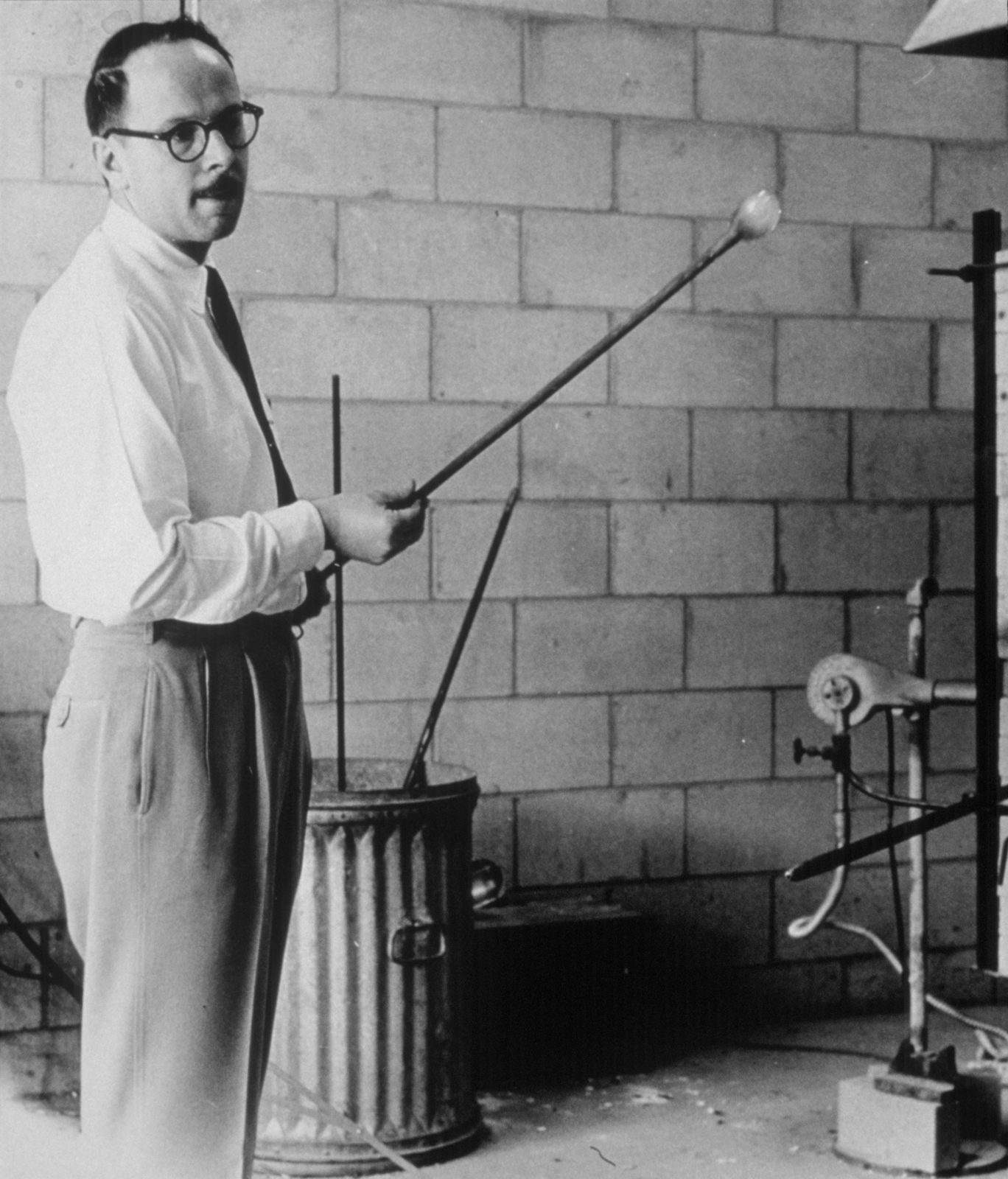
You may not know this about me, but I'm a glassblower. I began taking glassblowing classes while still in college, coming down to UrbanGlass, in Brooklyn, on the weekends. In the years since, I've continued my education both locally and at the Penland School of Crafts, and have both participated in and taught classes whenever possible while subsequently learning as much as I could about its history and craft through a Master's program in the History of Decorative Arts and Design. Glassblowing even introduced me to my husband, who I was fortuitously partnered with in one of my classes. Unfortunately, the studio that I worked out of for many years is now closed, leaving me without a good place to exchange my assistance for studio time. And as the option of renting time and space is currently prohibitively expensive, it's been a while since I've actually been worked in a glassblowing studio. Despite all that, however, my passion for the craft remains as strong as ever, and I still very much consider myself a glassblower. Then again, I have absolutely nothing on October's Designer of the Month, Harvey K. Littleton (b. 1922), a man without whom the modern craft of glassblowing would look very different indeed.

Harvey Littleton at the 1962 Toledo Workshop. Courtesy of the Corning Museum of Glass.

I mean, just look at the man. Because of the fact that glassblowing is such a hot and sweaty pursuit, you have to admit that working in pleated pants, a white dress shirt and a tie is a pretty bad-ass move. But Littleton is a pretty incredible glassblower. Widely recognized as the father of the American Studio Glass Movement, which celebrates its 50th anniversary this year, Littleton took glass from its place in the factory, introducing it to artists as a material for the creation of contemporary art.[1] 

Harvery Littleton, Red/Blue Combination Arc, 1984, Gift of Daniel Greenberg and Susan Steinhauser AC1997.249.12.1-.2. Courtesy of the Los Angeles County Museum of Art.

The son of a Corning Glass Works scientist, "a fascination with all aspects of the medium" was the driving force of Littleton's life.[2] An artist from a young age, Littleton was greatly influenced by his life at Corning and by the work of such figures as Frederick Carder, whose last years at Corning coincided with Littleton's early years, and whose work Littleton's mother purchased when it was being dispersed of by Steuben Glass.[3] Not only did Littleton grow up around Corning, but he took summer jobs there as well, learning as much as possible from these experiences about all aspects of glass and how to work with the material as much and in as many different ways as possible.[4] But Littleton had different ideas about glass than most people at the time. To give you an idea of the mindset and how radically different Littleton's thoughts about glassblowing were, Joan Falconer Byrd explains:
As 'a child of Corning,' Harvey had been tantalized by the vision of working creatively with glass. At the same time, he had been indoctrinated with Corning's dictum that to blow glass outside the factory was out of the questions. Two books by Steuben designer Sidney Waugh, the earlier of which he had been given as a teenager, discussed glass design within the factory context A quotation from Waugh's later book, The Making of Fine Glass, would appear as a point of reference in Harvey's 1959 application for funding for studio experiments in hot glassworking: 'It must be emphasized that glassblowing as described on these pages is not within the scope of the amateur or even the most talented artist or craftsman working alone.'[5]
Of course, as we know, that didn't deter Littleton from his belief in the feasibility of operating a studio-sized, rather than factory-sized glass furnace. But we'll get to all of that in the weeks to come. Over the next month, we'll take a look at the life and work of the man who changed the very face of glassblowing as we know it. I hope you'll join me.


[1] Russel Panczenko, "Forward," from Harvey K. Littleton: A Life in Glass, by Joan Falconer Byrd (New York, Skira Rizzoli Publications, Inc., 2011), IX.

[2] Joan Falconer Byrd, "Chapter One: Family History and the Influence of Corning," from Harvey K. Littleton: A Life in Glass (New York, Skira Rizzoli Publications, Inc., 2011), 3. 

[3] Ibid., 8.

[4] Ibid., 10-11.

[5] Ibid., 12.

Friday, September 28, 2012

Designer of the Month: Michael Heizer

Week 4: City

City (1972- ) is truly an unusual, visionary work, even for an artist like Michael Heizer. When it's complete, it will have the distinction as the largest sculpture in the United States. Even in its current, ongoing state, the work is so large - roughly eighty feet high, a quarter of a mile wide, and one and a quarter miles long - that when the energy department did a survey flyover of the area, they mistook it for a military project.[1]

Michael Heizer, 45º, 90º, 180º/City, 1980-1999. Garden Valley, Nevada. Photograph by Simon Norfolk/NB Pictures, for The New York Times.

Unlike Effigy Tumuli (1983-85), City is a project that was conceived entirely by Heizer himself. He began searching for land in the West where he could begin work in 1971, finally settling on an initial three-square-mile plot of land in the Nevada desert.[2] As Michael Kimmelman describes of the work in a 2005 article in The New York Times:
In 1972, Heizer acquired land in Garden Valley and began work on the first part of ''City,'' his own version of Easter Island or Angkor Wat: a modernist complex of abstract shapes -- mounds, prismoids, ramps, pits -- to be spread across the valley. It was to be experienced over time, in shifting weather, not from a single vantage point or from above but as an accumulation of impressions and views gathered by slowly walking through it. Artists in the 1960's and 70's -- Donald Judd, Andre, De Maria, Smithson, others -- were pushing sculpture off its pedestal. This was sculpture pushed all the way into the Western desert, the sort of work that you couldn't buy or sell even though it was very expensive to produce. Its materials were dirt and rock and cement and rebar, not marble or porcelain or bronze, and its tools were not chisels but heavy machinery.[3] 
It's a grand vision, and one that Heizer has said may take his lifetime to complete.[4] Heizer's vision for City is for a series of complexes within the desert. Complex One - a sloped, flat-topped mound with projecting beams - was completed in 1974, but since then, his work has reached somewhat of an impasse.[5] Complex Two and Three relate to One by forming a horseshoe - like a stadium open at one end - around a broad pit or plaza, but with continual logistical and equipment issues, they represent the greater problem of what happens over time with such a remarkably massive undertaking.[6] ''A lot of money over the years went into simply trying to maintain old, useless equipment,'' Heizer has explained; ''I never stopped working on the pit and the Complexes, whenever I could afford to. But we're talking crazy optimism here.''[7]

Michael Heizer at the City site, next to 45°, 90°, 180°/Geometric Extraction . Courtesy of the Public Art Foundation of Greater Des Moines.

After 27 years of work and a major setback in the form of a debilitating neurological disease, Complex Two and Three were finally completed in 1999.[8] In addition to the first three complexes, the concrete sculpture 45°, 90°, 180°/Geometric Extraction (1999), his most massive single positive sculptural shape to date, was added to the space during this time and is a focal point within the larger City landscape.[9] As Michael Kimmelman describes of the effect of the four works:
Complexes One, Two and Three, which are collectively nearly the size of Yankee Stadium, look tiny and precious. The new phases are more pneumatic -- raked dirt formations resembling hills, valleys and mountains. There is a patch of unspoiled sage, like a park, smack in the middle, for flood runoff through the valley (Heizer was thrilled to discover that it actually worked during the recent January storms); and there's now a concrete sculpture, ''45o, 90o, 180o,'' which both evokes ancient Egypt and resembles a board game on the scale of an airport hangar. ''I call it a defracted gestalt,'' Heizer said while slowly steering the truck to the steep precipice of what he calls Alpha mound. ''From the ground you grasp the size but can't make out the shapes -- the opposite of what you sense from the air -- and your perception changes as you move around.''[10]
And then, of course, there's the issue of money. Although the Dia Art Foundation and the Lannan Foundation are current supporters of the project, as a non-commissioned, private artistic undertaking, raising funds for the project has always been an issue for Heizer.[11] And until the project is complete, City remains, and will continue to remain, a very private work. Heizer eventually plans to open City to the public, but not until he completes the 15 miles of concrete curbs that delineate the mounds and shore up the dirt slopes, tasks he estimates could take another decade to complete.[12]


[1] Public Art Foundation of Greater Des Moines online, "Michael Heizer's 'City'," http://dsmpublicartfoundation.org/feature/michael-heizers-city/, (accessed September 25, 2012).

[2] Douglas C. McGill, "Introduction," from Michael Heizer: Effigy Tumuli, (New York: Harry N. Abrams, Inc., 1990), 19.

[3] Michael Kimmelma, "Art's Last, Lonely Cowboy," from The New York Times, February 6, 2005, http://www.nytimes.com/2005/02/06/magazine/06HEIZER.html?pagewanted=3, (accessed September 26, 2012).

[4] Douglas C. McGill, "Introduction," from Michael Heizer: Effigy Tumuli, (New York: Harry N. Abrams, Inc., 1990), 19.

[5]  Michael Kimmelma, "Art's Last, Lonely Cowboy," from The New York Times, February 6, 2005, http://www.nytimes.com/2005/02/06/magazine/06HEIZER.html?pagewanted=4, (accessed September 26, 2012).

[6] Ibid. 

[7] Ibid.

[8]  Michael Kimmelma, "Art's Last, Lonely Cowboy," from The New York Times, February 6, 2005, http://www.nytimes.com/2005/02/06/magazine/06HEIZER.html?pagewanted=5, (accessed September 26, 2012).

[9]  Michael Govan, "Exhibitions: Michael Heizer, Intoduction," Dia Art Foundation online, http://www.diacenter.org/exhibitions/introduction/83, (accessed September 26, 2012).

[10] Michael Kimmelma, "Art's Last, Lonely Cowboy," from The New York Times, February 6, 2005, http://www.nytimes.com/2005/02/06/magazine/06HEIZER.html?pagewanted=5, (accessed September 26, 2012).
 
[11] Michael Govan, "Exhibitions: Michael Heizer, Artist Biography," Dia Art Foundation online, http://www.diacenter.org/exhibitions/artistbio/83, (accessed September 26, 2012).

[12] Michael Kimmelma, "Art's Last, Lonely Cowboy," from The New York Times, February 6, 2005, http://www.nytimes.com/2005/02/06/magazine/06HEIZER.html?pagewanted=6, (accessed September 26, 2012).

Friday, September 21, 2012

Designer of the Month: Michael Heizer

Week 3: Effigy Tumuli

As we saw last week with North, East, South, West (1967/2002) and Double Negative (1969), Michael Heizer's work tends towards the sense of what I would like to call monumental minimalism. With his focus on creating large-scale, abstract negative spaces within specific landscapes, even when these works are at least somewhat recognizable as a geometric form, Heizer's work can sometimes be difficult to relate to. Which is one reason why Effigy Tumuli (1983-85) is such an interesting departure for Heizer.

Michael Heizer, Effigy Tumuli Water Strider, 1983-85. Buffalo Rock State Park, Ottawa, IL. Courtesy of California Home + Design.

A 224-acre landscape in Buffalo Rock State Park, Illinois, covered with five enormous earth mounds shaped like river animals, Effigy Tumuli is, at least to date, Heizer's one and only representational work. Of course, a work on this scale is only representational from a limited view point. From the air, they're immediately recognizable as animals. On the ground, however, rather than representative figures, the land more closely resembles a choppy landscape of furrows and hills, grown over with a carpet of colored rye, with the really big mounds so large as to suggest actual, natural hills.[1] So why would a purely abstract artist like Heizer suddenly wake up one day and decide to create a work of this nature? Why, he was commissioned, of course. In some ways, Effigy Tumuli was inspired by Heizer's childhood and trips with his father, the anthropologist Robert Heizer, on expeditions in Mexico, Central America and the deserts of the American West, where he became intimately familiar with the prehistoric art and architecture of America.[2] When he began working on Effigy Tumuli, Heizer was certainly aware that prehistoric Native Americans had built earth mounds, called tumuli, many of which still existed in the present day, but he was surprised to discover just how widespread the practice had been; literary thousands of these mounds cover the continent.[3] Of the source material and representational aspect of the project, Heizer explains:
It's an untapped source of information and thematic material. It's a beautiful tradition, and it's fully neglected. And it's from a group of people who were genocided. So, in a lot of ways, the Effigy Tumuli is a political and social comment. To me it is...The criterion was earth-moved sculpture, period. All domestic material. Nothing imported. No gravel, no wood, no concrete, no metal. Just dirt."[4]
Michael Heizer, Effigy Tumuli Catfish, 1983-85. Buffalo Rock State Park, Ottawa, IL. Courtesy of Live Auctioneers.

But even from the start of the project, Heizer had trouble with the very representational nature of Effigy Tumuli. In the years leading up to his actual work on the site, after agreeing to the commission and firming up a contract, Heizer became intimately familiar with the Buffalo Rock site. In the summer of 1983, he walked over the entire site, memorizing the terrain and taking thousands of photographs, which he would eventually enlarge and mount in his studio as dozens of photographic collages - some ranging in size up to six feet long and three feet high - that he used throughout the project for both reference and information.[5] Heizer was inspired to create his own versions of prehistoric effigy and ceremonial mounds both from his experience with them as a child and from his research and reading into the history of the mounds in the Midwest, particularly Illinois.[6] He explains:
It's in the nature of my work that I keep in mind the environment I'm taken into. And the native American tradition of mound building absolutely pervades the whole place, mystically and historically and in very sense. Those mounds are part of a global, human dialogue of art, and I thought it would be worthwhile to reactivate that dialogue. I thought, this won't be some Disneyland-looking kind of a park. It will be reminiscent of that native American history. And people out there seem proud to of having these mounds. They get people excited. So, it's good material for a public work...The obligation was to maintain that ancient dialogue, and so I couldn't just come in with some modernist sculptural geometry.[7]
But it was exactly this struggle - a need to create representational images to remain true to the project's vision crossed with an entire career thus far spent exploring abstraction - that led Heizer to the ultimate decision of river animals as the proper subjects for his mounds.[8] After realizing that the Native Americans had never created insect-shaped mounds, Heizer's initial design called upon these forms as his own innovative spin on the mound-building tradition; the ultimate forms of the mounds as river animals, however, came when Heizer grew increasingly disenchanted with the idea, and instead decided to draw on the typography of the area and the Illinois River as a source of inspiration.[9] Of course, while they're recognizable as representational animals, the final forms themselves - a snake, catfish, turtle, frog, and a water strider - are inherently geometric in nature, thus maintaining Heizer's connection to abstraction.[10]


[1] Douglas C. McGill, "Introduction," from Michael Heizer: Effigy Tumuli, (New York: Harry N. Abrams, Inc., 1990), 14.

[2] Ibid., 10.

[3] Ibid., 11.

[4] Ibid., 11.

[5] Ibid., 21-22.

[6] Ibid., 22.

[7] Ibid., 22-23.

[8] Ibid., 25.

[9] Ibid., 25

[10] Ibid., 34.