Showing posts with label nature. Show all posts

Friday, February 14, 2014

daily needs

Developed with "social (back to basics), ecological (materials and function) and economic (local production) relevance" in mind, Studio Segers has designed the Daily Needs Modular Chicken Coop & Garden.


It's not every day that you see such a beautiful, multi-purpose product. With all the components you need to assemble housing for chickens and small pets, garden and vegetable beds, a composting bin, and a tool shed, all in a configuration of your choice, Daily Needs is a very well-designed, sleek solution for both the urban and suburban farmer. See more at Studio Segers.


(Via Design Milk)

Monday, November 11, 2013

beauty of mathematics


We all know that mathematics underlies our daily lives, but few of us truly grasp the systems at work. Beauty of Mathematics, by Yann Pineill & Nicolas Lefaucheu, looks to change all of that. Using the form of a triptych, this short film takes you through a lovely series of illustrated mathematical concepts, each of which is contextualized in a way that clearly showcases its beauty. Watch it in full screen!


(Via swissmiss)

Wednesday, September 25, 2013

lottas trees


Beautiful tree illustrations by Swedish designer Lotta Olsson. I love the way these float in space, as if the entire tree has been pressed and preserved between glass. See more on her website and purchase prints in her shop.


(Via Design Mom)

Wednesday, September 18, 2013

kono designs - urban farm

The Japanese recruitment firm Pasona has a very beautiful and quite unusual Tokyo headquarters. Urban Farm, by Kono Designs is a 9-story-high, 215,000 sq. ft. corporate office building with over 43,000 sq. ft. of green space, representing the largest and most direct farm-to-table building of its kind; 200 species of fruits, vegetables and rice are harvested, prepared and served in the building's cafeteria.


According to the designers:
Using both hydroponic and soil based farming, crops and office workers share a common space. For example, tomato vines are suspended above conference tables, lemon and passion fruit trees are used as partitions for meeting spaces, salad leaves are grown inside seminar rooms and bean sprouts are grown under benches. The main lobby also features a rice paddy and a broccoli field. These crops are equipped with HEFL, fluorescent and LED lamps and an automatic irrigation system. An intelligent climate control monitors humidity, temperature and breeze to balance human comfort during office hours and optimize crop growth during after hours. This maximizes crop yield and annual harvests. Seasonal flowers and orange trees are planted on the balconies between the double skinned facade, partially relying on natural exterior climate to showcase changing of leaves and colors to the exterior facade. All plants are maintained and harvested by Pasona employees with the help of an agricultural specialist.
Pasona Urban Farm is beyond aesthetic and visual improvement. It creates a unique workplace environment that promotes worker's productivity, mental health, and social interaction and engages the wider community of Tokyo by showcasing the benefits and technology of urban agriculture.
Don't you wish you worked here?


Friday, August 23, 2013

dino pet


I've always been fascinated by bioluminescence, and if Dino Pet is any indication, so has Yonder Biology. Of course, they've actually gone and done something cool with their preoccupation by creating a living habitat for bioluminescent marine algae in the shape of a dinosaur. Why a dinosaur you might ask? Well, considering that dinoflagellates are the source of this natural night light, the dino shape seemed quite fitting. As they describe of the project:
Our goal with this Kickstarter campaign (and most all of our projects) is to present biology in a fun and inspiring manner.  We’ve had an amazing time experimenting with the dinoflagellates (or as we like to call them, "dinos") in our bio light and in plastic bags, jars and any uniquely shaped containers we could get our hands on.  But the time has come to give these dinos a form!  And what form is more fitting than a Brontosaurus, err an Apatosaurus...
That's right! Dino Pet has been getting a ton of great press and has already met it's campaign goal, but it's not too late to pledge and purchase one of these dinos for yourself on Kickstarter.


(Via Colossal)

Thursday, August 1, 2013

adrift


I never imagined that fog could be so engaging, but Simon Christen certainly did. He's the filmmaker behind Adrift, a "love letter to the fog of the San Francisco Bay Area." Shot over a period of two years, Christen captured his remarkable time lapse video of the fog gliding in over the hills, the bridge and the city by waking up at 5am every morning to check that the weather conditions would be perfectly aligned. Attempting to evoke the same feeling of happiness that accompanied these stunning scenes, Adrift is an extraordinary work that represents a collection of his favorite shots from these excursions.

(Via Colossal)

Friday, July 26, 2013

Aki Inomata


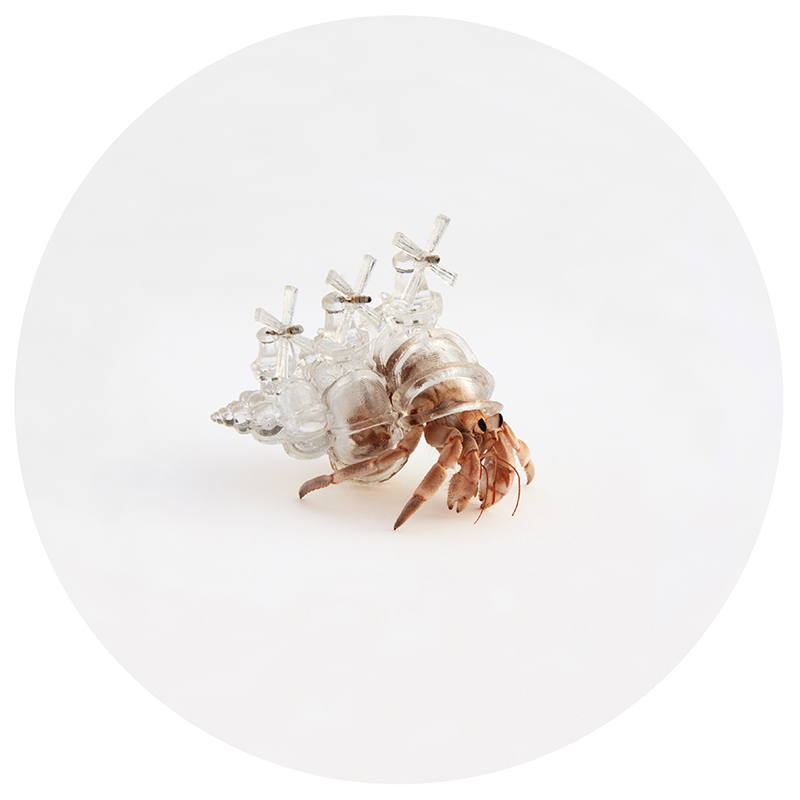
I first came across Japanese artist Aki Inomata's work at The Armory Show a few years ago, and while Why Not Hand Over a 'Shelter' to Hermit Crabs? (2009; 2010)was far and away my favorite work at the show, I pretty much forgot about her until just the other day, when I received a friendly reminder from designboom.


Inomata creates her clear plastic homes for hermit crabs based on the architecture of major cities. Because hermit crabs are so picky about their homes, to begin the process, she scans abandoned hermit crab shells, using these to base her designs. Next, she uses 3-D software to slightly enlarge the shells and design her elaborate cityscapes, using a rapid prototyping system to produce the finished shells. Finally, these are introduced to the hermit crabs, who get to chose the city in which to make their new home. As Inomata explains:
In this piece I gave hermit crabs shelters that I had made for them, and if they liked my shelters, I got them to use them as their shell.

I overheard that the land of the former French Embassy in Japan had been French until October 2009; that it was to become Japanese for the following fifty years, and then be returned to France. This concept made me think of hermit crabs, which change their shells. The same piece of land is peacefully transferred from one country to the other. These kinds of things take place without our being aware of it. On the other hand, similar events are not unrelated to us as individuals. For example acquiring nationality, moving, and migration.

The hermit crabs wearing the shelters I built for them, which imitate the architecture of various countries, appeared to be crossing various national borders. Though the body of the hermit crab is the same, according to the shell it is wearing, its appearance changes completely. It’s as if they were asking, “Who are you?”
Great concept, right? You can see more of Inomata's fascinating work on her website.


(Photographs © Aki Inomata)

Wednesday, June 19, 2013

1012 terra

Daisuke Tsumanuma and Kenichi Yamada, of 1012 Terra, have truly elevated the terrarium to new artistic heights.


I don't know about you, but I've certainly never seen such elegant examples of your ordinary rock, soil and plant-filled terrarium as the ones that 1012 Terra has created. Not only have they changed the basic shape of the terrarium from the traditional round or domed vessel by creating lovely rectangular glass and metal soldered options, but by pairing down the contents, the actual beauty of the plants themselves are given a chance to shine. Simply stunning.

(Via The Fox Is Black)

Monday, March 11, 2013

Patrick Jacobs

Gold Cap Cluster #2, 2011. Styrene, acrylic, cast neoprene, paper, polyurethane foam, hair, wood, steel, lighting, BK7 glass. 2-inch exposed lens. Interior box dimensions: approximately 10.6 (wide) x 14.4 (high) x 8.75 (deep) inches.
  
I must say, I was very pleasantly surprised by this year's contemporary section at the Armory Show. The past few years had left me fairly underwhelmed, but I actually found quite a lot to like about this year's group of galleries and artists.  Of course, there are always a few stand-outs, and Patrick Jacobs and his miniature, bucolic sculptures was definitely one of my favorites.

 Fairy Ring with Dandelions, 2010. Styrene, acrylic, neoprene, hair, paper, polyurethene foam, wood, hair, steel, lighting, BK7 glass. 8-inch exposed lens. Interior box dimensions: 48.25 (wide) x 30.25 (high) x 23.25 (deep) inches.

Fairy Ring Mushroom Cluster #5, 2012. Styrene, acrylic, cast neoprene, paper, polyurethane foam, hair, wood, steel, lighting, BK-7 Glass 2-inch exposed lens. Interior box 10.6 x 14.4 x 8.75 inches.

Raked Leaves (Detail), 2011. Styrene, acrylic, cast neoprene, paper, polyurethane foam, hair, wood, steel, lighting, BK7 glass. 7.5-inch exposed lens. Interior box dimensions: approximately 33 (wide) x 28 (high) x 28 (deep) inches.

Fly Agaric Cluster #2, 2011. Styrene, acrylic, cast neoprene, paper, polyurethane foam, hair, wood, steel, lighting, BL7 glass. 2-inch exposed lens. Interior box dimensions: approximately 14 (wide) x 10 (high) x 9 (deep) inches.

Each of Jacobs' works is a meticulously constructed, three-dimensional diorama installed within the wall and viewed through a circular glass lens. Even with the dimensions listed, it's difficult to get a sense of the scale of these works, but the illusion that's created by them, which gives the viewer a sense of peering into a secret, seemingly infinite landscape, is both otherworldly and magical.
Jacobs draws inspiration from sources as diverse as historical landscape painting and contemporary chemical companies’ home and garden pest control brochures, such as Chevon’s Ortho Books. Recalling the Claude glass, an optical device popular in the 18th century used to frame the picturesque, the lenses invoke the invisible eye of the wary homeowner searching an otherwise vacant domestic landscape for imagined interlopers. Ortho, Greek for “correct,” further alludes to the unending quest to control any divergence from the norm, as well as the manipulation of our sense of perspective. With such a fusion of influences, these quiet compositions offer a magical view of the mundane. Here, reality has been de-familiarized, and the uncanny has supplanted the commonplace.
See more of Jacobs' work at Pierogi Gallery.

Wednesday, January 23, 2013

Ella Robinson


UK-based artist Ella Robinson's love of found materials pairs beautifully with her training as a textile artist in these colorful driftwood works. Created from either cotton thread or plastic tubing, Robinson's decorative objects are enticingly, brightly appealing.

(Via The Jealous Curator)

Monday, January 21, 2013

Dillon Marsh - invasive species

There is nothing subtle about cell phone towers disguised as trees, and South African photographer Dillon Marsh has captured these faux-natural oddities in all of their splendor with his Invasive Species series.


In 1996 a palm tree appeared almost overnight in a suburb of Cape Town. This was the world's first ever disguised cell phone tower. Since then these trees have spread across the city, South Africa and the rest ofthe world.

Invasive Species explores the relationship between the environment and the disguised towers of Cape Town and its surrounds.
See more of this surreal series here, and find more or Marsh's work on his portfolio and Behance site. 

(Via The Design Ark)

Monday, November 19, 2012

paz arquitectura - casa corallo

There's no denying the beauty of Casa Corallo, designed by Guatemalan architecture firm, Paz Arquitectura. But more than just a simply stunning residence, Casa Corallo is unique in the ways in which it's managed incorporate the existing wooded and mountainous topography of the landscape into its design.


Because, rather fight the landscape, Casa Corallo embraces it to such an extent that it was actually designed around the existing trees on the property, some of which now grow directly through the house itself. Additionally, the incorporation of large glass windows and use of different types and textures of wood throughout truly give the sense that this home is a part of the hillside, making for an incredibly beautiful home.

(Via Design Milk)