Showing posts with label weaving. Show all posts

Monday, January 27, 2014

voices of industry

Adele Stafford is a weaver and the owner of Voices of Industry, for which she crafts simply exceptional cloth in her Oakland, CA studio, all of which is 100% farmed and spun in the US.


The garments that are made from this cloth are pretty stunning - her first collection was inspired by Sally Fox, a farmer, breeder and pioneer of the naturally colored cotton that was used to create each piece. I love that all the color in these garments comes directly from the plant, and would never have imagined the broad range and subtle colors possible for cotton.
We consider the farmers that produce our cotton and wool as co-conspirators and friends. We invest in the independent grower, the biodynamic alchemist and the punk rock shepherdess. We know that cloth is a direct extension of agriculture and we care, deeply, about that origin. 

We seek collaboration as a way of building industry, firm in the belief that our best work can only come from shared process and expertise. All of our work is grown, woven and sewn in the U.S.
It's a beautiful first collection, and I can't wait to see what Adele comes up with next. Find out more on Voices of Industry's website.


(Photography by Brian Ferry. Via Miss Moss)

Thursday, March 21, 2013

Mimi Jung - weavings


It's hard for me to admit this, but textiles are one art form that is all but missing from my home. It's not for a lack of enthusiasm - I absolutely adore the fiber arts - but while my walls may be hung salon-style, textiles are sadly under-represented. Of course, I wouldn't mind remedying this fact, particularly if it meant adding one of Brook&Lyn's Mimi Jung weavings to my collection. Created primarily from yarn and other natural materials and hung on copper, Jung's tactile, multidimensional colorful hangings would be an incredible addition to any collection. See them all on Brook&Lyn's website.

(Via Design*Sponge)

Monday, October 29, 2012

Faig Ahmed


Double stretching, 2011. Woolen, handmade carpet, 100smX230sm.

Thread Intallation

Wave wood, 2011. woolen handmade carpet, 200smX250sm.

Stretching, 2011. Woolen handmade carpet, 100smX230sm.

Wave plastic, 2012. Woolen handmade carpet, 200smX250sm.

Stretched, unraveled, sculpted, and reinterpreted, artist Faig Ahmed's work masterfully redefines the Azerbaijani tradition of carpet making. According to his artist's statement:
Carpet is more a time structure than a graphical one. Initially it was considered as a sophisticated sort of writing rather than a mere decorative piece. And to read those written signs is a temporal process. By separating those signs and symbols Faiq switches the carpet from two-dimensional plane to three-dimensional space where it comes to life. Basically the artist trenches upon a sancta sanctorum of Azerbaijanian carpet-making tradition. But being a modern-day version of a God’s fool the artist easily gets away with it. With this technique the artist translates traditional carpet language into universal language of contemporary art, making it understandable for the rest of the people. 
See more of these incredible textile works on Ahmed's website.

(Via The Jealous Curator and designboom)

Wednesday, August 8, 2012

Monday, September 12, 2011

Donna Wilson - furniture collaborations


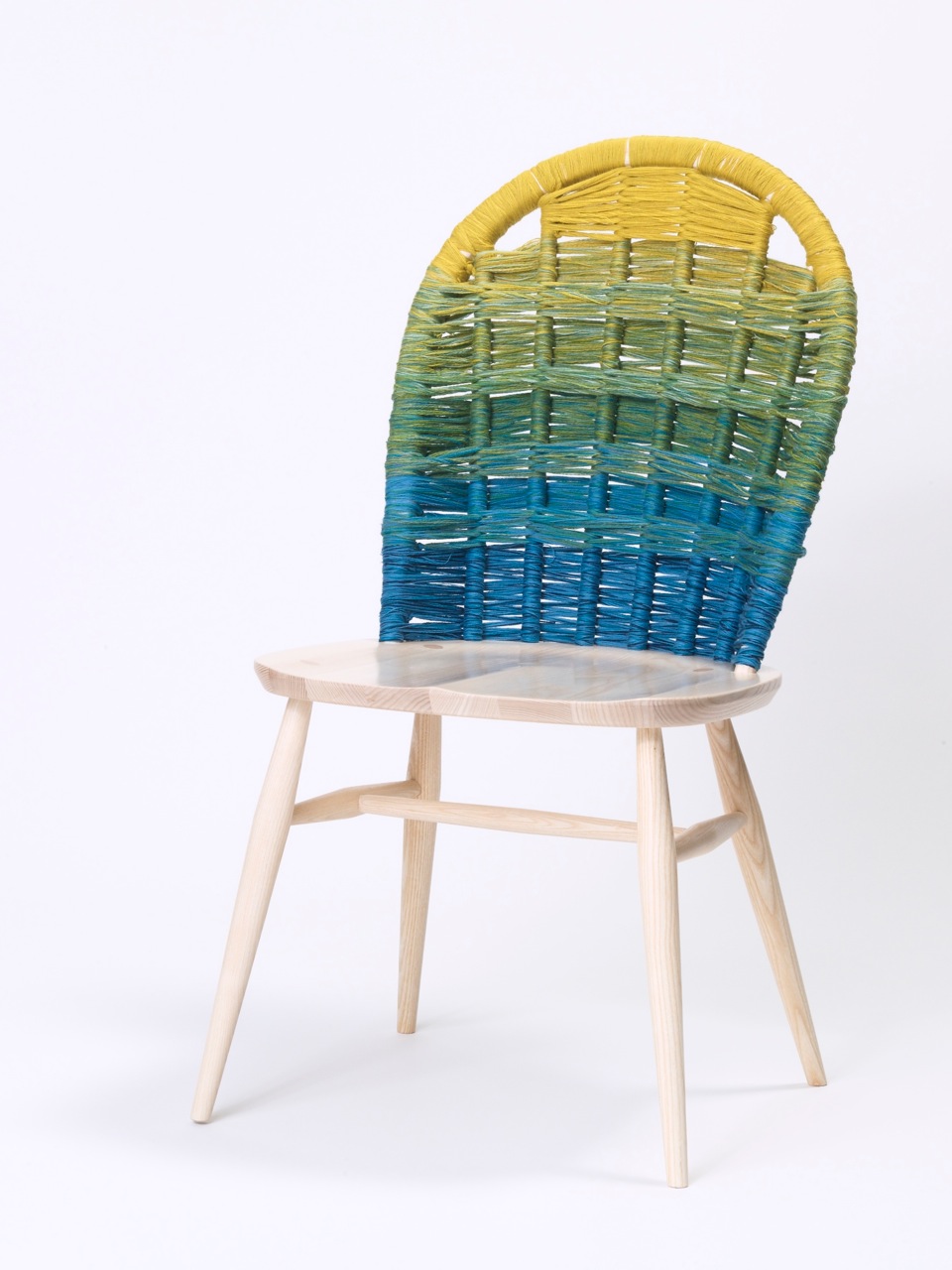
Some new work from Donna Wilson - furniture collaborations with SCP and one-off wrapped pieces from Ercol. I love the different colors and textures that the addition of woven and wrapped fabric brings to these. If you happen to live in Brussels, head to La Fabrika on September 16th for an in-person look at what sure to be a great collection.

Friday, November 26, 2010

Designer of the Month: Trude Guermonprez

Week 4: three-dimensional weaving and portraits

Trude Guermonprez, Arachne, 1963. Oakland Museum of Art, The Tapestries of Trude Guermonperez, Introduction by Hazel V. Bray (Oakland, CA: Oakland Museum, 1982), Published in conjunction with the exhibition “The Tapestries of Trude Guermonprez” shown at the Oakland Museum, 12.

In the early 1960s, around the same time as her "textile graphic" work, Trude Guermonprez, allied with the fiber artist Lenore Tawney (1907-2007) to pioneer the creation of some of the first three-dimensional weavings.[1] These pieces were entirely non-functional and utilized weaving techniques never before attempted. They brought the woven piece off the wall and floor and into the three-dimensional realm. In 1961, Guermonprez and Tawney exhibited a group of these experimental “space hangings”, bringing great acclaim to Tawney, who incorporated this technique into her overall aesthetic, while Guermonprez decided to abandon it.[2] Guermonprez later incorporated a similar idea of the double-woven structure, the basis for these hangings, as a design element in some of her work, but never again took up the idea of the woven object as transcending the realm of the two-dimensional.[3] As Jan Janeiro explains:
Both artists dealt initially with tapestry, creating interlacings of fibers of different materials–wools, linens, silks, etc.– and varying weights, both of which were active and visible in warp as well as weft. Warps were left unwoven; eccentric wefts built up curvilinear areas of sculptural relief; and pattern weaves were used to create additional texture and visual movement.[4]
This building up of and unconventional use of materials, combined with an original use of weaving techniques to create these unconventional works, was an additional way that Guermonprez helped to change and impact the world of textiles. As Guermonprez discusses this technique in relation to her Banner series, “Lately I have designed three-dimensional space hangings, which are completely planned and woven on the loom. Their functional use so far is one of the old tradition. That of banners, flags and kites.”[5] Referencing the functionality of these pieces is a testament to the Bauhaus tradition of the theoretical need for well-designed and practical objects, and shows how Guermonprez’s educational background continued to be an influential part of her work. This background may have contributed to Guermonprez’s choice to rapidly move her work in different directions, mastering a technique and then returning to incorporate elements from it.[6]

 Trude Guermonprez, Notes to John and Notes to John I, 1966. Trude Guermonprez Archives, Cooper-Hewitt, National Design Museum Library, New York.

It wasn’t until the 1970s, at the end of her career, that Trude Guermonprez moved away from the Bauhausian ideas of functionality and concentrate on creating new esoteric and less directly representational work, referring back to and fully realizing the potential of the self-portrait textile graphics briefly alluded to in the 1950s. As Guermonprez explains:
My recent period of Textile Graphics started around 1970. It is too close to the present to know the reason for these pieces. Except that more and more an awareness of our ties with the universe seems to occupy my feelings and I sense a quietening of passions in our personal lives which gives strength and freedom from anxieties.[7]
Using photographs, drawings and lettering, with the textile graphic assuming a dominant role, Guermonprez’s later work combined the imagery of her poetry and portraiture to express her ideas about life.[8] The few different pieces that stand out as illustrative examples of this are Guermonprez’s Notes to John and Notes to John II (1966), Our Mountains (1971), and her final work, Mandy’s Motto: The Wind Don’t Blow One Way All The Time (1975).  In Notes to John, Guermonprez combines the traditions of letter writing and weaving in a very non-traditional way. As Jan Janeiro writes:
Woven during an absence from her husband, these “letters” illustrate the strengths of her work– technical control of woven structures at the service of a quiet, personal vision, and a biographical intimacy that can be shared by the viewer because its specificity has been transformed into a metaphorical statement.[9]
Trude Guermonprez, Our Mountains, 1971. Oakland Museum of Art, The Tapestries of Trude Guermonperez, Introduction by Hazel V. Bray (Oakland, CA: Oakland Museum, 1982), Published in conjunction with the exhibition “The Tapestries of Trude Guermonprez” shown at the Oakland Museum, 14.

During the 1970s, Guermonprez’s work shifted towards a more intimate and highly personal aesthetic.  This change includes a much greater use of unconventional materials and techniques.  In these works in particular, this movement away from Guermonprez’s earlier style is also seen in Our Mountains, where she uses portraiture to create the image of mountains. The piece shows a mountainous landscape incorporating the reclining profile face of her husband, John Elsesser, facing right to create the mountain peaks, with Guermonprez’s own profile facing left to form the hills beneath.[10] This tapestry speaks to Guermonprez’s use of portraiture while similarly transcending the traditional self-portrait genre and venturing into the metaphoric realm, with self-portraiture used “not as self-declaration but as a gentle and hopeful recognition of personal redemption.”[11] Similarly, Guermonprez’s final work, Mandy’s Motto: The Wind Don’t Blow One Way All The Time, veers into the metaphoric realm, bringing together many techniques from her varied career, including the three-dimensional double-weave, now incorporated as an aesthetic detail rather than entirely structural form, and the use of printed text as lettering, to create what has been called “her most personal work with the sureness of the mature artist who has fond what is necessary and compelling to say.”[12]

Trude Guermonprez, Mandy's Motto: The Wind Don't Blow One Way All The Time, 1975. Oakland Museum of Art, The Tapestries of Trude Guermonperez, Introduction by Hazel V. Bray (Oakland, CA: Oakland Museum, 1982), Published in conjunction with the exhibition “The Tapestries of Trude Guermonprez” shown at the Oakland Museum, 18.

The 1970s saw a revived interest in traditional handcraft techniques, paralleling the continued emergence and increased interest in the fiber arts movement in America.[13] While the techniques of utilizing printed graphics, weaving with nontraditional materials, and incorporating superfluous sewn, woven and knotted elements into the formally rigid design of the woven structure had all been methods utilized by Guermonprez for some time, such ideas about what the fiber arts were and could become were just beginning to slip into the American public’s conscience.


[1] Jan Janeiro, "Trude Guermonprez: A Quiet Journey," Surface Design Journal, (Fall 1991), 8.

[2] American Craft Museum, Lenore Tawney: A Retrospective, ed. Kathleen Nugent Mangan (New York: Rizzoli, 1990), published in conjunction with the exhibition “Lenore Tawney: A Retrospective” shown at the American Craft Museum.

[3] Jan Janeiro, "Trude Guermonprez: A Quiet Journey," Surface Design Journal, (Fall 1991), 8.

[4] Ibid., 8.

[5] Ibid., 8.

[6] Herbert Bayer, Walter Gropius, and Ise Gropius (eds.), “Weimar Bauhaus: 1919-1925,” Bauhaus: 1919-1928 (Boston: Charles T. Branford Company, 1959), 16.

[7] Hazel V. Bray, “Introduction,” The Tapestries of Trude Guermonprez (Oakland, CA: Oakland Museum, 1982), published in conjunction with the exhibition “The Tapestries of Trude Guermonprez” shown at the Oakland Museum, 19.

[8] Ibid., 19.

[9] Jan Janeiro, "Trude Guermonprez: A Quiet Journey," Surface Design Journal, (Fall 1991), 8.

[10] The Museum System, Drawing, Trude and John as Landscape, Study for the Tapestry “Our Mountains”, Cooper-Hewitt National Design Museum.

[11] Jan Janeiro, "Trude Guermonprez: A Quiet Journey," Surface Design Journal, (Fall 1991), 8.

[12] Ibid., 8.

[13] Mary Schoeser and Whitney Blausen, “‘Wellpaying Self Support’: Women Textile Designers,” Women Designers In the USA, 1900-2000: Diversity and Difference, Pat Kirkham (ed.) (New Haven: Yale University Press, 2000), 160.

Friday, November 19, 2010

Designer of the Month: Trude Guermonprez

Week 3: Pond Farm Workshop, other teaching positions and "textile graphics"

 Trude Guermonprez, Small Banner, 1965. Oakland Museum of Art, The Tapestries of Trude Guermonperez, Introduction by Hazel V. Bray (Oakland, CA: Oakland Museum, 1982), Published in conjunction with the exhibition “The Tapestries of Trude Guermonprez” shown at the Oakland Museum, 13.

In 1949, following her resignation from Black Mountain College, Trude Guermonprez taught at the Pond Farm Workshops in Guerneville, California, where a friend from her school days in Halle, the potter Marguerite Wildenhain, another Bauhaus-educated craftsperson, along with Wildenhain’s husband and a group of artists, were attempting to create their own version of a an ideal educational setting.[1] The objective of Pond Farm was to facilitate:
…a place where artist-craftsmen live…The school of the Pond Farm Workshops offers students the opportunity to serve an apprenticeship under the artists of this group. It is their belief that the essential demands of life, work, and art can better be taught in contact with a productive workshop than academically by theory or class room training. The interchange of ideas and experience of students with teachers, and of one workshop with the others, leads to more integrated and basic work in the special fields, while as a group of workshops they can solve together problems related to architecture, industrial design and production.[2]
Pond Farm, while having an academic focus, was never actually a college. Instead, the school adopted the title of “workshops” in order to help situate the academic focus of the school within the craft community. Like Black Mountain College, Pond Farm Workshops was only open a short time, from 1949 until 1953, holding the idea of small artist community with workshops built-in to it at its core.[3] Guermonprez spent her time teaching classes and workshops both at Pond Farm and in San Francisco, where she developed a class entitled “Elements of Textile Design” at the California School of Fine Arts, now the San Francisco Art Institute.[4] During this time Guermonprez also taught summer sessions at the California College of Arts and Crafts in Oakland, now the California College of the Arts, where she was hired as full-time faculty in 1954, and where she remained until her death in 1976, acting as faculty as well as chairperson of the Division of Crafts.[5]

 Trude Guermonprez, section of Spring, ca. 1970. Cotton, wool, linen, viscose, metal, lurex, and plastic. 1993-121-35, Cooper-Hewitt, National Design Museum, New York.
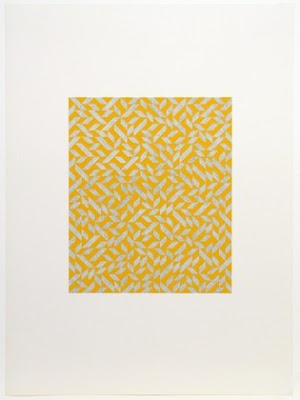
The 1950s and 1960s, following her tenure at Pond Farm, was a time of technical exploration for Guermonprez.[6]  In 1951 she completed her first Self-Portrait.  This piece, along with the pictorial Leaf Study, is a precursor to a group of what Guermonprez was to refer to as her “textile graphics”, and which would become the basis for later work.  As she discussed about the decision to create a self-portrait and the process of doing so:
I had married again and perhaps found a new reason for being. Self-portraits seem to be milestones of such moments…Thinking still of the angular forms which are characteristic of straight weaving techniques, I made a cubist portrait which then mellowed out from the structure of weaving and the overlapping colors of the weft.[7]
These textile graphics, while similar in nature to her pictorial weavings, expand upon her earlier method of graphic representation.  Here, she concentrates more on choice of woven material and technique, in a manner that provides layers of meaning and interpretation through the use of imagery.  Unlike her later work, Guermonprez spent the majority of her career creating pieces that were much more abstract in nature, using shapes, colors, materials, and pattern to suggest imagery. This was also a period when Guermonprez spent a lot of time experimenting weaving with nontraditional and new materials, such as metal, viscous and plastics.


[1] Jan Janeiro, "Trude Guermonprez: A Quiet Journey," Surface Design Journal, (Fall 1991), 6.

[2] Tim Tivoli Steele, “School of the Pond Farm Workshops: An Artists’ Refuge,” A Report From the San Francisco Craft and Folk Art Museum 10, no. 2 (1992).

[3] Ibid.

[4] Yoshkio Uchida, “Trude Guermonprez,” Craft Horizons, (March/April 1959): 30.

[5] California College of Arts and Crafts, “Trude Guermonprez” Technology into Poetry,” The California College of Arts and Crafts Review, no. 5 (December 1982).

[6]  Jan Janeiro, "Trude Guermonprez: A Quiet Journey," Surface Design Journal, (Fall 1991), 8.

[7] Ibid., 8.

Friday, November 12, 2010

Designer of the Month: Trude Guermonprez

Week 2: Black Mountain College

While Trude Guermonprez did not attend the Bauhaus, her schooling was greatly influenced by this important institution. Guermonprez studied at the Municipal School of Arts and Crafts, where the majority of the faculty was composed of Bauhaus-educated teachers, with Gerhard Marcks, a former master at the Bauhaus, serving as the school’s director.[1] Also in Germany, at the School of Textile Engineering in Berlin, Guermonprez studied with another former Bauhaus student, Benita Otte-Kuch, one of the most accomplished of the Bauhaus’s weaving students.[2] At the close of World War II that Guermonprez left Europe for America, taking her first teaching job at Black Mountain College, in North Carolina.[3]

 Trude Guermonprez, Detail of First Snow, 1957. 1993-121-1, Cooper-Hewitt, National Design Museum, New York.

I'm not going to go into the whole background of Black Mountain College, since I wrote a lot about it last year, suffice it to say that Black Mountain held as its core the belief in the idea that the arts should be central to any education and integrated into all aspects of a liberal curriculum.[4] In 1947, under the guise of a visiting weaving consultant - a necessary requirement to get her into the country - her family, who worked at Black Mountain College, and whom had been unsure of her safety during the war years, expedited Guermonprez's arrival in the United States.[5] While the visit was only meant to be a short one, it happened to coincide with a sabbatical leave of the Albers.[6] Anni, head of the weaving department at the school, invited Guermonprez, along with Franziska Mayer, a student at and fellow European émigré, to run the department in her absence.[7] When Albers returned the following year, Guermonprez was invited to stay on as permanent faculty, working as a teacher while also creating her own work.[8]

  Trude Guermonprez, Leaf Study, 1948. Trude Guermonprez Archives, Cooper-Hewitt National Design Museum Library, New York. 

Along with the designs that Guermonprez executed for private commissions, her most well-known piece from the time is the tapestry Leaf Study (1948), based on a leaf motif created by a painted warp, a technique called pictorial weaving that Guermonprez and Anni Albers were both experimenting with at the time, and which was perfected at Black Mountain.[9] Pictorial weavings had been one of the main focuses of textile design at the Bauhaus, with both Guermonprez and Albers taking up this method and working to add to and refine it throughout their careers. As Guermonprez explains about the process and how it relates to her own work:
At that time pictorial weaving had been done mostly in the Gobelin technique, where the weft thread carried the color and formed the image. Often painters were the designers of those tapestries, and trained weavers had executed them. My thought then was this: Painters used woven canvas as the base for their brushwork; why then should not I, as a weaver, enter the process at an earlier phase. I would paint on the warp and see how subsequently the perpendicular interlacing of the weft would later color and texture…Still in the grip of tradition, I asked a painter friend at Black Mountain to make a design which I could paint on the warp. This is how Leafstudy came about.[10]
Similar techniques of printing images onto finished woven pieces, such as batik and other screenprinting processes, had been around since the early 1900s, and were made popular by such designers as Marion Dorn, Ilonka Karasz and Ruth Reeves.[11] Taking the idea of the printed image and working with it in a new way, Guermonprez and Albers’ notion of painting the warp directly rather than printing on a finished piece further integrated painting into the weaving process, creating nuances of color that could not otherwise be achieved. While the history of pictorial weaving is a long one, dating back to medieval tradition of tapestry design, it was a traditional process that utilized the weaver as a technician only, whereas this new pictorial weaving process combines the work of both the painter, who designs a work, and the weaver, who executes the design, merging these two distinct artists into one. Not only does the weaver design and implement the work, but the entire piece is enhanced by the use of a painted warp, being thought less of as the separate entities of warp and weft, but as a single work.[12] This pictorial approach to weaving is carried throughout Guermonprez’s career, although she quickly abandons the idea of actually painting on the warp, creating woven pieces that embody the same painterly aspects of these first works without the actual use of paint. This approach is particularly indicative of the idea of the whole craftsperson, one whose creation is theirs from start to finish, one of the tenets of the Bauhaus and a continuation of the Arts and Crafts ideal, an idea that continued to influence Guermonprez throughout her life.[13]


[1] Anna Rowland, “Introduction,” The Bauhaus Source Book, 6. 

[2] Mary Emmas Harris, The Arts at Black Mountain College (Cambridge: MIT Press, 1987), 132.

[3] Jan Janeiro, "Trude Guermonprez: A Quiet Journey," Surface Design Journal, (Fall 1991), 6.

[4] Mary Emmas Harris, "Introduction," The Arts at Black Mountain College (Cambridge: MIT Press, 1987), xxi.

[5] Ibid., 132.

[6] Jan Janeiro, "Trude Guermonprez: A Quiet Journey," Surface Design Journal, (Fall 1991), 6.

[7] Mary Emmas Harris, The Arts at Black Mountain College (Cambridge: MIT Press, 1987), 132.

[8] Jan Janeiro, "Trude Guermonprez: A Quiet Journey," Surface Design Journal, (Fall 1991), 6.

[9] Mary Emmas Harris, The Arts at Black Mountain College (Cambridge: MIT Press, 1987), 132.

[10] Hazel V. Bray, “Introduction,” The Tapestries of Trude Guermonprez (Oakland, CA: Oakland Museum, 1982), published in conjunction with the exhibition “The Tapestries of Trude Guermonprez” shown at the Oakland Museum, 6.

[11] Mary Schoeser and Whitney Blausen, “‘Wellpaying Self Support’: Women Textile Designers,” Women Designers In the USA, 1900-2000: Diversity and Difference, ed. Pat Kirkham (New Haven: Yale University Press, 2000), 148.

[12] Jan Janeiro, "Trude Guermonprez: A Quiet Journey," Surface Design Journal, (Fall 1991), 6-7.

[13] Anna Rowland, “Introduction,” The Bauhaus Source Book (New York: Van Nostrand Reinhold, 1990), 10.

Friday, November 5, 2010

Designer of the Month: Trude Guermonprez

Last November, I wrote about the textile artist and weaver Anni Albers as my Designer of the Month. This November, I'm going to be discussing another textile artist and weaver, a contemporary of Albers who is of special interest to me not only because of her amazing work, but also because I spent a year researching and writing about her for my Master's thesis. That's right my friends, I'm talking about Trude Guermonprez. While I am very aware that the name probably doesn't ring any bells for most people, especially not in the way that Anni Albers' name does, I hope that by the end of the month, you'll all see just what exactly is so interesting about this talented woman. Watch out now, because this is where the real decorative arts and design dork in me gets to shine.

 
 Courtesy of the Trude Guermonprez Archives, Cooper-Hewitt National Design Museum Library, New York.

Trude Guermonprez (1910-1976), born Gertrud Jalowetz, dedicated her life to the fiber arts.[1] Guermonprez was born in Danzig, Germany into a family of artists. She chose to stay in Europe and work in the textile industry while her parents and sister fled to the United States to teach at Black Mountain College in North Carolina, escaping the rise of National Socialism.[2] Guermonprez came to textiles, and to weaving in particular, during her education at the Municipal School of Arts and Crafts at Halle, Germany.[3] Known as the “Little Bauhaus” because of the large number of faculty who studied there, the Municipal School of Arts and Crafts was where pupils disseminated the ideals and principles of the school, and was influential in shaping Guermonprez’s aesthetic and weaving style.[4] The effects of this education had a lasting impact on Guermonprez’s work and subsequent teaching style. The school continued to influence Guermonprez throughout her life, affecting the choice of institutions in which she would spend her time once immigrating to the United States. But that's a story for next week. Just like with Albers, I'm going to spend this month discussing Guermonprez's career chronologically, looking at her time teaching at Black Mountain College in week 2, her experience at the Pond Farm Workshops and her "textile graphics" pieces in week 3, and her three-dimensional and portrait works in week 4.


[1] Jan Janeiro, "Trude Guermonprez: A Quiet Journey," Surface Design Journal, (Fall 1991), 6.

[2] Ibid., 6.

[3] Ibid., 6.

[4] Ibid., 6.

Friday, November 27, 2009

Designer of the Month: Anni Albers

Week 4: Connecticut

Anni Albers, Plate II from the portfoli Line Involvements, (June 8-15, 1964). Lithograph, composition and sheet: 14 3/4 x 19 13/16" (37.5 x 50.3 cm). Gift of Kleiner, Bell & Co. © 2009 The Josef and Anni Albers Foundation / Artists Rights Society (ARS), New York. Courtesy of the Museum of Modern Art.

After leaving Black Mountain College, Anni and Josef Albers moved to Connecticut, where Josef was chairman of the Department of Design at the Yale University School of Art,from 1950 to 1958.[1] This move, of course, in no way slowed Albers down. While in Connecticut, where Anni and Josef settled for the remainder of their lives, Anni continued to weave, design and write.[2] As Nicholas Fox Weber recalls about the Albers in his book The Bauhaus Group:
The couple in their white khaki clothing spoke with unparalleled clarity and intensity about the making of art. They emphasized the need for morality and modesty in painters, designers, and architects, as in everyone else who hoped to advance humanity. They both marveled at simple things - the form of an egg, the cleverness of egg cartons - just as they deplored pretense and corruption, of which they considered the New York art world a prime exemplar. These were just some of the ways in which they kept the true spirit of the Bauhaus alive.[3]


Anni Albers, W/CO, 1974. Screenprint and photolithograph, offset printed. Gift of the Josef and Anni Albers Foundation in fond memory of Eunice Fearer. © 2009 The Josef and Anni Albers Foundation / Artists Rights Society (ARS), New York. Courtesy of the Museum of Modern Art.

While textiles and weaving continued to be her main focus, in 1963, Anni Albers began to explore the new medium of printmaking, producing a group of lithographs and screenprints of great spatial and textural complexity.[4] What's interesting about Albers' work at this time is the very distinct sense of experimentation. Albers wanted to be able to reproduce her own deliberately irregular pencil work, allow for crystalline edges and to capture a range of grays that had never been possible in any other of the print mediums in which she'd worked, and so she chose to learn the photo-offset process - a combination of photographic repoduction and printing - combining this with traditional screenprinting in order to achieve the desired effect in her work.[5]

Anni Albers, cover of On Weaving, 1965. Courtesy of The Joseph and Anni Albers Foundation.

It was also during this time, in 1965, that Albers published what would become her most well-known and celebrated text, On Weaving.[6] As the Josef and Anni Albers Foundation explain about this period of her life, "Like Josef, she focused above all on her work—happy to pursue it at a remove from the trends and shifting fashions of the art world. In 1984, Anni wrote, '... to comprehend art is to confide in a constant.'"[7]


[1] The Josef and Anni Albers Foundation online, “An Introduction,” http://www.albersfoundation.org/Albers.php?inc=Introduction (accessed November 24, 2009).

[2] Ibid.

[3] Nicholas Fox Weber, "Anni Albers," The Bauhaus Group (New York: Alfred A. Knopf, 2009), 380.

[4] The Josef and Anni Albers Foundation online, “An Introduction,” http://www.albersfoundation.org/Albers.php?inc=Introduction (accessed November 24, 2009).

[5] Nicholas Fox Weber, "Anni Albers," The Bauhaus Group (New York: Alfred A. Knopf, 2009), 385.

[6] The Josef and Anni Albers Foundation online, “An Introduction,” http://www.albersfoundation.org/Albers.php?inc=Introduction (accessed November 24, 2009).

[7] Ibid.

Friday, November 20, 2009

Designer of the Month: Anni Albers

Week 3: Black Mountain College

As I mentioned last week, Anni and Josef Albers emigrated to the United States at the urging of Philip Johnson, whom had be charged with finding someone to run Black Mountain College's art department.[1] Now, Black Mountain has a bit of a special place in my heart. A good portion of my Master's thesis, which discussed the work of Trude Guermonprez, a weaver, textile artist, fellow Bauhausian, contemporary, and student of Anni Albers, was devoted to the subject of Black Mountain. So what, exactly, made this school so interesting? Well, for starters, in addition to the Albers' and Guermonpez, some of the more notable names of the 20th century spent time at Black Mountain, including the artists Willem and Elaine de Kooning, Robert Motherwell, Robert Rauschenberg, and John Chamberlain, the writers Charles Olson, Anaïs Nin, and Robert Creeley, the engineer and visionary Buckminster Fuller, the composers John Cage and Stefan Wolpe, the choreographer Merce Cunningham, and the dancer Paul Taylor.[2]

Black Mountain College, North Carolina, ca. 1942. Photo: Will Hamlin Courtesy of the N.C. Office of Archives and History, Raleigh, North Carolina and the Joseph and Anni Albers Foundation.
John Andrew Rice and Theodore Dreier founded Black Mountain College, an experimental and progressive interdisciplinary school located in North Carolina, in 1933, with Rice as the innovator and Dreier as teacher, fund-raiser, and as a link to the New York art world (including, Philip Johnson).[3] While only remaining in session until 1956, Black Mountain held as its core the belief in the idea that the arts should be central to any education and integrated into all aspects of a liberal curriculum, attracting a wide range of avant-garde artists, writers and performers, including many Bauhaus-educated and inspired teachers and students like Anni Albers, who headed the weaving department.[4]
Anni Albers, Display Fabric Sample, 1944. Cellophane and jute, 35 x 38" (88.9 x 96.5 cm). Gift of the designer. © 2009 The Josef and Anni Albers Foundation / Artists Rights Society (ARS), New York. Courtesy of the Museum of Modern Art.
Anni Albers's weaving program was meant as an alternative to craft classes in which nothing more than "ashtray art" was produced.[5] For Albers, weaving was a serious and complex process that involved responding to materials, the structure of textiles, and to function, and of all the workshops at the school, it was the most successful.[6] Under Albers's tutelage, weaving and textile design were taught as a "preparatory step to machine production," with the structure of the weave rather than color or texture emphasized.[7] This emphasis on structure made the textiles at Black Mountain distinguished by their limitation of color, serving as a foil for other objects.[8]

Anni Albers, Drapery, 1945. Cotton and metal foil, 13 1/2 x 17" (34.3 x 43.2 cm). Gift of the designer. © 2009 The Josef and Anni Albers Foundation / Artists Rights Society (ARS), New York. Courtesy of the Museum of Modern Art.

Black Mountain College is most-often described in conjunction with the word "experiment." It was an experiment in education and in art, and the work created at the school is a reflection of this. Albers may have taught weaving as a step on the road towards machine production, but she also encouraged experimentation in both her own and her student's work, most notably in her use of abstracted imagery and incorporation of unconventional materials.[9] Rayon, jute and metallic threads were used beside cotton and linen, not only in her own work, but in her designs for commercial textiles as well.[10]

Anni Albers, Tapestry, 1948. Handwoven linen and cotton, 16 1/2 x 18 3/4" (41.9 x 47.6 cm). Edgar Kaufmann, Jr. Purchase Fund. © 2009 The Josef and Anni Albers Foundation / Artists Rights Society (ARS), New York. Courtesy of the Museum of Modern Art.

Albers' time at Black Mountain was when her career as an artist really flourished, culminating in her 1949 solo exhibition at the Museum of Modern Art.[11] In addition to her flourishing career as an artist and commercial textile designer, this was also the time when Albers became prolific as an author, all while working as a teacher at the school.[12] During their time at Black Mountain, Josef and Anni also traveled widely, both in the United States and Mexico, a country that "captivated their imagination and had a strong effect on both of their art."[13] In addition to all this work and travel, it's amazing to think not only of Albers' impact on the weaving and textile world at the time, but the impact that her students went on to have as well, many of whom (Ruth Asawa, Sheila Hicks, Dorothy Ruddick, and Trude Guermonprez) went on to became the first generation of studio artists in the U.S. working with fiber.[14]

Anni Albers, Free-Hanging Room Divider, 1949. Cellophane and cord, 94 x 32 1/2" (238.7 x 82.5 cm). Gift of the designer. © 2009 The Josef and Anni Albers Foundation / Artists Rights Society (ARS), New York Courtesy of the Museum of Modern Art.

The Albers were connected with Black Mountain for 16 years, finally leaving when the school took a direction that they didn't see as appropriate.
[15] In 1950, the Albers moved to Connecticut, where Josef took a position teaching at Yale, and where Anni continued writing, teaching and weaving.[16]


[1] Tara Leigh Tappert, "Artists and Advocates," Craft in the Machine Age: The History of Twentieth-Century American Craft, 1920-1945, ed. Janet Kardon (New York: Harry N. Abrams, Inc., 1995), 227.

[2]
Vincent Katz, “Black Mountain College: Experiment in Art,” in Black Mountain College: Experiment in Art, ed. Vincent Katz (Cambridge: MIT Press, 2002), 18.

[3] Ibid., 15, 18.

[4] Mary Emma Harris, “Introduction,” The Arts at Black Mountain College, (Cambridge: MIT Press, 1987), xxi.

[5] Janet Kardon, "Craft in the Machine Age," Craft in the Machine Age: The History of Twentieth-Century American Craft, 1920-1945, ed. Janet Kardon (New York: Harry N. Abrams, Inc., 1995), 27.

[6] Ibid., 27.

[7] Marcia Yockey Manhart, "Charting a New Educaitonal Vision," Craft in the Machine Age: The History of Twentieth-Century American Craft, 1920-1945, ed. Janet Kardon (New York: Harry N. Abrams, Inc., 1995), 65.

[8] Ibid., 65-6.

[9] Vincent Katz, “Black Mountain College: Experiment in Art,” in Black Mountain College: Experiment in Art, ed. Vincent Katz (Cambridge: MIT Press, 2002), 25.

[10] Ibid., 25, 31.

[11] Ibid., 25.

[12] Ibid., 25, 31.

[13] The Josef and Anni Albers Foundation online, “An Introduction,” http://www.albersfoundation.org/Albers.php?inc=Introduction (accessed November 17, 2009).

[14] Marcia Yockey Manhart, "Charting a New Educaitonal Vision," Craft in the Machine Age: The History of Twentieth-Century American Craft, 1920-1945, ed. Janet Kardon (New York: Harry N. Abrams, Inc., 1995), 66.

[15] Vincent Katz, “Black Mountain College: Experiment in Art,” in Black Mountain College: Experiment in Art, ed. Vincent Katz (Cambridge: MIT Press, 2002), 24.

[16] The Josef and Anni Albers Foundation online, “An Introduction,” http://www.albersfoundation.org/Albers.php?inc=Introduction (accessed November 17, 2009).

Friday, November 13, 2009

Designer of the Month: Anni Albers

Week 2: The Bauhaus (1922-1933)

Founded in Weimar, Germany in 1919 and shut down by the Nazis in 1933, the Bauhaus brought together artists, architects, and designers in conversation about the nature of art in the age of technology.[1] As Harvey Green explains about the importance of the Bauhaus in his essay "The Promise and Peril of High Technology:"
Its premise was simple: The form of an object, or a building, derives from its function. Bauhaus designers rigorously avoided the use of applied ornament and attempted to give their objects a machine-made look, yet their creations were 'in reality craft products which through the use of geometrically clear basic shapes gave the appearance of industrial production.'[2]

Anni Albers, Design for Bedspread, 1928. Watercolor and pencil on paper, 12 13/16 x 10 3/16". © 2009 The Josef and Anni Albers Foundation / Artists Rights Society (ARS), New York. Courtesy of the Museum of Modern Art.

Walter Gropius's original manifesto for the Bauhaus called for the building of a "new guild of craftsman without the class distinctions that rise an arrogant barrier between craftsman and artist."[3] The members of the Bauhaus, teacher and student alike, wanted to replace what they saw as outmoded values not by toppling the existing framework, but by forging connections and seeing their ways accepted and integrated.[4] Albers recalls that, once she was settled in, she "was deeply involved in the Bauhaus and thought there was no more interesting place on earth...There were things I didn't care for very much, but it was in my eyes the school at the time and the school for me"[5]

Anni Albers, Design for Theater Curtain, Oppeln, 1928. Gouache on paper, 4 1/2 x 13 7/8" (11.4 x 35.2 cm). Gift of the designer. © 2009 The Josef and Anni Albers Foundation / Artists Rights Society (ARS), New York. Courtesy of the Museum of Modern Art.

Anni Albers' time at the Bauhaus was marked by experimentation - in the materials for weaving and in her designs for wall hangings and textiles - with her work exhibiting a strong sense of geometry, structure and pattern.[6] She was of the leading textile artists at a school where weaving was one of the most important activities, especially for a woman.[7] Stained glass, carpentry, wall painting, and metalwork, all of the workshops that Albers had hoped to participate in, were denied to her on the basis that the work was too strenuous.[8] While it's true that women were often denied access to some of the more "masculine" workshops, they did in fact allow for female students to attend classes.[9] In Albers' case, the real issue was Charot-Marie-Tooth disease, an incurable genetic illness that causes muscular atrophy, and which was discovered (although not until the 1980s) to be the real reason for her difficulty walking and occasional tremors.[10] This led Albers to the weaving workshop; although she had to operate the pedals on the looms, they did not require much muscle, and it allowed for her to work while seated.[11]
Anni Albers, Drapery Material, 1927. Cotton and rayon, 15.9 x 10.8 cm (6-1/4 x 4-1/4 inches). The Museum of Modern Art, New York. Gift of the designer. Digital Image © 2003 The Museum of Modern Art, New York.

After graduating from the Dessau Bauhaus in 1930, Albers because an instructor in textiles at the school and acting director of its weaving workshop.[12] As an instructor she "expected other people to make mistakes, and took pleasure in being the one who occasionally had an answer."[13] In both her wall hangings and the functional materials that she created, Albers was a pioneer.[14] Her work not only helped change the look of upholstery and drapery, but by hanging her weaving on the wall as art, she helped invent a new form of abstract art, in addition to her work teaching writing essays about weaving and design that would have a great impact on the textile design world.[15]

Anni Albers, Wall Hanging, 1926. Silk, 189.9 x 122 cm (72 x 48 inches). © 2003 The Josef and Anni Albers Foundation / Artists Rights Society (ARS), New York. Courtesy of the Busch-Reisinger Museum, Harvard University Art Museums, Association Fund.

In 1933, after the closing of the Bauhaus, Albers met our old friend, architect Philip Johnson (September's Designer of the Month), in Berlin.[16] It was Johnson who arranged for Anni and Josef to emigrate the United States, where they went to teach at Black Mountain College, in North Carolina.[17] And so, as you've probably noticed, all of the images from this week are from Albers' time at the Bauhaus. Next week, it's on to Black Mountain.

Anni Albers, Sound Absorbing and Light-reflecting Wall Covering Material, 1929. © 2003 The Josef and Anni Albers Foundation / Artists Rights Society (ARS), New York.


[1] The Museum of Modern Art online, "Bauhaus 1919–1933: Workshops for Modernity," http://www.moma.org/visit/calendar/exhibitions/303 (accessed November 10, 2009).

[2] Harvey Green, "The Promise and Peril of High Technology," Craft in the Machine Age: The History of Twentieth-Century American Craft, 1920-1945, ed. Janet Kardon (New York: Harry N. Abrams, Inc., 1995), 40.

[3] Nicholas Fox Weber, "Anni Albers," The Bauhaus Group (New York: Alfred A. Knopf, 2009), 362.

[4] Ibid., 362.

[5] Ibid., 363.

[6] The Josef and Anni Albers Foundation online, “An Introduction,” http://www.albersfoundation.org/Albers.php?inc=Introduction (accessed November 4, 2009).

[7] Nicholas Fox Weber, "Anni Albers," The Bauhaus Group (New York: Alfred A. Knopf, 2009), 342-3.

[8] Ibid., 355.

[9] Ibid., 356.

[10] Ibid., 356.

[11] Ibid., 356.

[12] Tara Leigh Tappert, "Artists and Advocates," Craft in the Machine Age: The History of Twentieth-Century American Craft, 1920-1945, ed. Janet Kardon (New York: Harry N. Abrams, Inc., 1995), 227.

[13] Nicholas Fox Weber, "Anni Albers," The Bauhaus Group (New York: Alfred A. Knopf, 2009), 363.

[14] Ibid., 357.

[15] Ibid., 357.

[16] Tara Leigh Tappert, "Artists and Advocates," Craft in the Machine Age: The History of Twentieth-Century American Craft, 1920-1945, ed. Janet Kardon (New York: Harry N. Abrams, Inc., 1995), 227.

[17] Ibid., 227.